"Sí, Acepto" y "I Do": How to Plan a Bilingual Wedding Ceremony That Honors Every Voice in the Room
There's a moment in every bilingual wedding ceremony that stops the room — when the officiant shifts from English to Spanish, and the relatives who've been leaning forward, straining to follow, finally exhale. You see it in their faces: this is for us too. That moment doesn't happen by accident. It's designed, intentionally, by couples who understand that their wedding isn't just a union of two people. It's a union of two families, two cultures, two worlds.
Planning that ceremony — one that moves with equal grace through both languages — is one of the most meaningful and underestimated acts of love you can put into a wedding day.
Why Language Is an Act of Love
For bicultural couples and families with roots in Spanish-speaking communities, language is identity. When Abuela doesn't speak English, or when Tío flew in from Colombia for the first time in fifteen years, the way a ceremony handles language is a signal — about who belongs, who is seen, and what this union actually values.
A ceremony that treats Spanish as an afterthought — a brief translation tucked in at the end, or a single sentence offered as a courtesy — is felt. Equally, a ceremony that moves organically between English and Spanish, that gives both languages equal presence and emotional weight, creates something genuinely bicultural rather than just bilingual. The difference is significant, and couples who've been through it will tell you: the room feels different.
Structuring the Flow — English and Spanish in Balance
The most elegant bilingual ceremonies are not simply translated versions of each other. They're written together, in both languages simultaneously, so that each section of the ceremony exists in both tongues with its own rhythm and emotional arc.
A few structural approaches that work beautifully:
The Woven Approach — The officiant moves between languages naturally throughout the ceremony, so no single language "owns" any particular section. Vows are offered in both languages. Readings are given in one language and echoed in the other. The effect is seamless and genuinely bicultural, though it demands an officiant fluent in both.
The Parallel Approach — Each element is delivered in full in one language, then in full in the other. This works especially well when the guest list is clearly divided — say, an English-speaking side and a Spanish-speaking side — because each group gets an uninterrupted experience before the other community receives theirs. It runs slightly longer but is structurally clean.
The Role-Based Approach — Readings, blessings, and ceremonial elements are assigned by language: a Spanish prayer or blessing from a family elder, English vows, a bilingual unity ritual. This approach integrates both communities into the ceremony structure itself and often produces the most emotionally resonant moments.
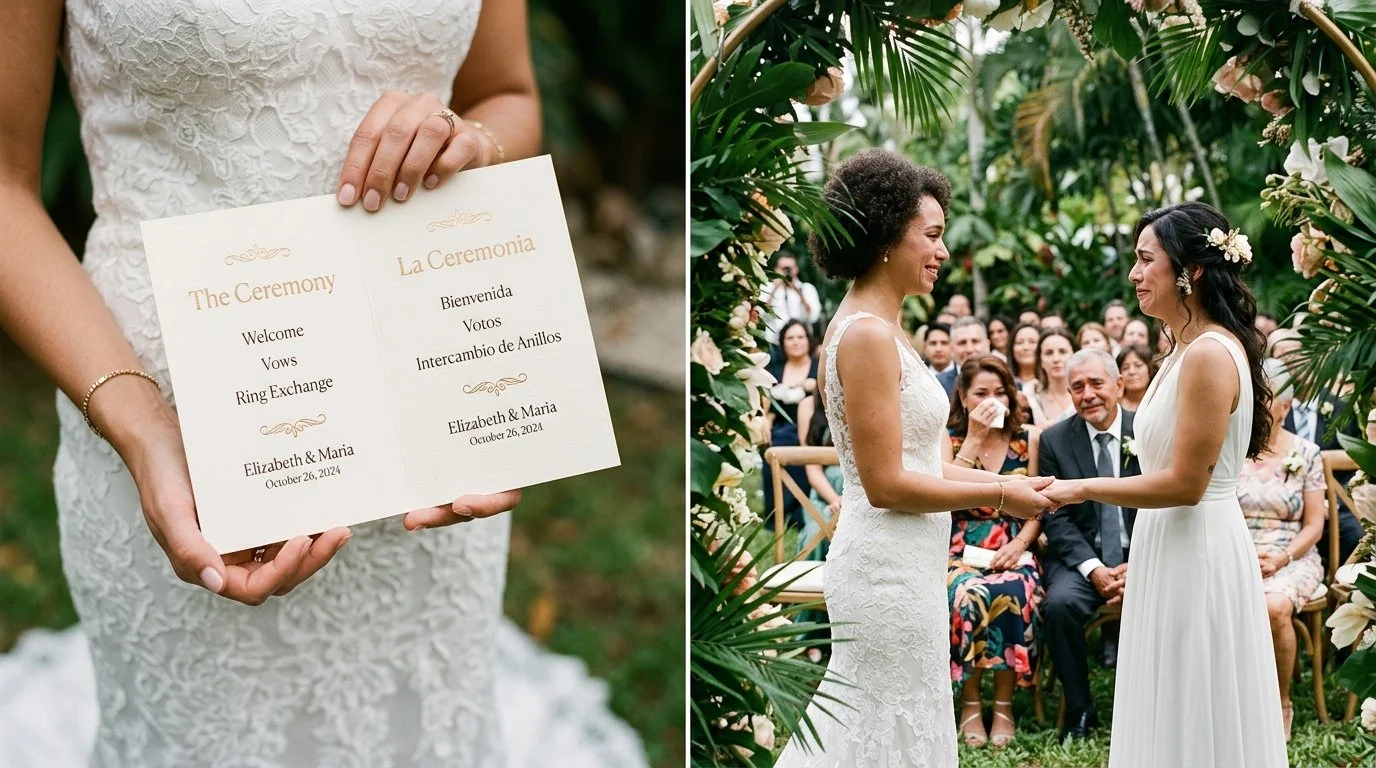
The program matters too. A bilingual ceremony program — Spanish on one panel, English on the other — allows every guest to follow along regardless of their primary language. It signals intentionality before the first word is spoken.
The Vows: Writing "I Do" in Two Languages
Vows are the emotional core of any ceremony, and in a bilingual context they carry even more weight. Couples often choose to write their personal vows in one language — the language in which they think and feel most naturally — while the formal declarations are offered in both.
If you're writing bilingual vows from scratch, resist the temptation to simply translate. The cadence of Spanish and the cadence of English are not the same, and a beautiful line in one language often needs to be reimagined, not just converted. Work with your officiant on this — a skilled bilingual officiant will help you find the emotional equivalent in each language rather than a word-for-word translation.
Some phrases carry their meaning better in Spanish. "Te escojo a ti, hoy y siempre" — "I choose you, today and always" — lands differently in Spanish, with a weight that doesn't fully transfer. Keep those moments. Let them belong to the language in which they resonate most deeply.
Working With a Bilingual Officiant — What to Look For
Not every bilingual officiant is the same, and for a ceremony this intentional, the difference matters. You're looking for someone who is genuinely fluent — not conversationally proficient, but ceremonially fluent, comfortable with the emotional vocabulary and cultural cadences of both languages.
Ask specifically how they've structured bilingual ceremonies before. Ask to see a sample script. Ask whether they write ceremonies collaboratively with couples or deliver a templated script. The best bilingual officiants understand that they're holding space for two cultural identities simultaneously, and they approach that responsibility with the same care they'd bring to the vows themselves.
Wilton Vida's officiant services are rooted in exactly that fluency — not just linguistic, but cultural. We've officiated ceremonies where the family elders spoke no English, where the vows needed to honor Cuban traditions alongside American ones, where the ceremony itself was the first time two families truly shared the same room. We write every ceremony from scratch, in collaboration with the couple, in both languages — and we show up on the day fully prepared to hold the emotional weight of both worlds.
The Details That Make It Feel Complete
Beyond the script itself, a few intentional details complete the bilingual experience:
A unity ritual with dual meaning — the arras ceremony, the lazo, or a candle lighting that bridges both cultural traditions — gives the ceremony a physical, visible symbol of the union that transcends language entirely.
Music between sections — even a brief instrumental transition played on classical guitar, or a piece that belongs to both cultures, creates breathing room and shifts the register naturally between languages.
A bilingual welcome — opening the ceremony in both languages, from the very first sentence, signals immediately to every guest that this space belongs to all of them. That signal is felt, even before anyone processes the words.
Whatever the structure, the goal is the same: when the ceremony ends, both families should feel like they were fully present for it — not observers of someone else's moment, but participants in their own.
Wilton Vida would be honored to help you plan and officiate a ceremony that holds every voice in the room. Reach out at wiltonvida.com or connect with us directly on WhatsApp at https://wa.me/message/YUIL7UEHTZDAM1. Con mucho gusto.