How to Notarize a Power of Attorney in Florida
A power of attorney is one of the few documents where the execution matters as much as the language. You can have the right agent named, the right powers granted, and the right intent behind all of it — and still hand a bank a document it will not accept, because of something that happened in the room on the day it was signed. Florida is specific about that room. Here is what the state actually requires and where people most often go wrong.
What Florida Requires
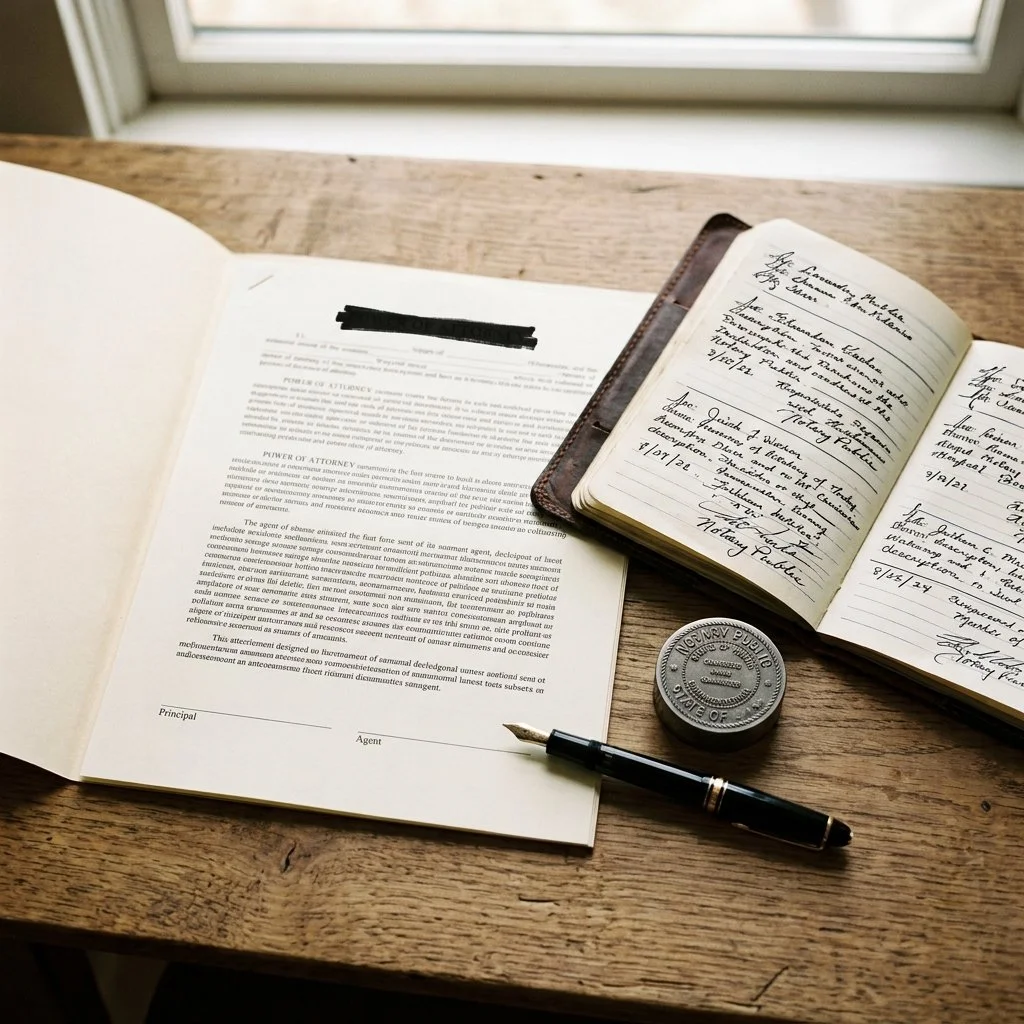
Under Florida Statutes §709.2105, a power of attorney must be signed by the principal, signed by two subscribing witnesses, and acknowledged by the principal before a notary public. All three elements. Missing any one of them is not a technicality that gets cured later — it is the difference between a document that works and a document that does not.
The agent named in the instrument must be a natural person eighteen or older, or a financial institution with trust powers and a place of business in Florida authorized to conduct trust business here. And if the principal is physically unable to sign, the statute provides a path: the notary before whom the acknowledgment is made may sign the principal’s name on the document, following the procedure set out in §117.05(14). That provision exists for exactly the situations families encounter — a hospital bed, a hand that will not cooperate — and it is used properly far less often than it should be, usually because nobody in the room knew it was available.
One more piece worth knowing before the signing: Florida requires certain broad authorities to be separately signed or initialed by the principal, next to each enumerated power, rather than granted by the document’s general language. Gifting authority, changes to survivorship interests, and beneficiary designations are the common ones. If those initials are missing, those specific powers do not exist, even though the rest of the document stands.
The Signing Order Is Not Optional
The most common failure we see has nothing to do with the document’s contents. It is sequence.
The principal signs in the presence of the two witnesses. The witnesses then sign. The principal then acknowledges the signature before the notary. When people sign in the wrong order — or, more often, when witnesses sign a document they did not actually watch the principal sign — the execution is compromised in a way that is very hard to fix after the fact. “Subscribing witness” means a witness who was there. Passing the document around an office for signatures is not the same thing, and a signing agent who watches that happen is obligated to stop it.
Who Cannot Be in Which Chair
Roles do not overlap the way people assume. The notary and the witnesses should be different people. A Florida notary cannot notarize their own signature, nor the signature of a spouse, parent, or child. And while Florida does not disqualify an interested witness the way some states do, having the named agent — or the agent’s spouse — serve as a witness is an invitation to a challenge later. When the document is contested, the first thing anyone examines is who was standing where.
Our default guidance is simple: use two disinterested witnesses who have no stake in the instrument, and keep the notary entirely separate from all of it.
Identification, and Why It Is Strict
A Florida notary must establish the principal’s identity through a current government-issued photo identification, through personal knowledge of the individual, or through the sworn statement of two credible witnesses who personally know the person signing. Expired identification is not acceptable identification. Neither is a photograph of a license on a phone.
This is the step where mobile appointments most often stall, and it is entirely preventable. Before the appointment, confirm the identification is current, confirm the name on it matches the name typed into the document, and if it does not — a maiden name, a middle initial, a suffix — say so in advance so the document can be corrected before anyone is sitting at a table.
Can It Be Done Remotely?
Yes, and the answer has a caveat worth understanding.
Florida permits remote online notarization, and a power of attorney can be executed that way. But when witnesses appear remotely by audio-video technology rather than physically with the principal, and the document contains certain provisions — including the banking and investment authorities enumerated in §709.2208 — Florida imposes additional requirements under §117.285(5). The platform must present the principal with a statutory notice and a set of screening questions, and the notary must weigh the answers as part of their duties.
The consequence that matters most: if the principal is a vulnerable adult as defined in §415.102, remote witnessing by audio-video technology is not effective for that signature. Florida defines a vulnerable adult broadly — an adult whose ability to perform daily activities or provide for their own care is impaired by mental, emotional, sensory, long-term physical, or developmental disability, brain damage, or the infirmities of aging. In practical terms, if the person signing is elderly, recovering, or in declining health, the witnesses need to be physically in the room even if the notary is on screen.
That is a distinction that costs families real money when it is discovered after the fact rather than before. It is also the distinction most online notarization platforms explain least clearly.
What We Do Differently
Wilton Vida handles powers of attorney as mobile signings across Broward, Miami-Dade, and Palm Beach, and remotely where remote is genuinely appropriate for the document and the signer. As an NNA Certified Signing Agent, background screened, NNA member #400164321, the procedural discipline is the point of the engagement — not an add-on to it.
In practice that means the call happens before the appointment, not at it. We confirm the identification is current and matches. We confirm who the witnesses will be and that they are disinterested and will actually be present. We confirm whether the document contains authorities that trigger the heightened remote requirements, and if it does and the signer’s circumstances raise the vulnerable-adult question, we tell you plainly that this one needs to be done in person. And we walk the signing in the correct order, because the order is the part nobody remembers under pressure.
One boundary, stated clearly: we are notaries, not attorneys. We do not draft powers of attorney, we do not tell you which powers to grant, and we do not advise on whether the document says what your situation requires. That is legal work and it belongs with a Florida attorney. What we do is make certain that whatever your attorney drafted is executed in a way the receiving institution will accept.
If you have a power of attorney that needs signing — this week, at a hospital, at a kitchen table, or on screen — reach out to our team at wiltonvida.com or connect with us on WhatsApp at https://wa.me/message/YUIL7UEHTZDAM1
Estamos aquí para ayudarle en español también — escríbanos y con gusto le atendemos.