Nile & Mekong River Cruises: What First-Timers Need to Know
Two rivers, thousands of years apart in the imagination and roughly nine thousand miles apart on a map, keep landing on the same short list. Clients who have already done the Mediterranean, done the Caribbean, done a transatlantic in a suite come to us asking about the Nile and the Mekong — and almost always in the same breath, as though the two were interchangeable. They are not. But the instinct behind the question is exactly right. River cruising is the most efficient way to see a civilization from the inside, and these two rivers do it better than almost anywhere else on earth.
Here is what a first-timer should understand before choosing between them.
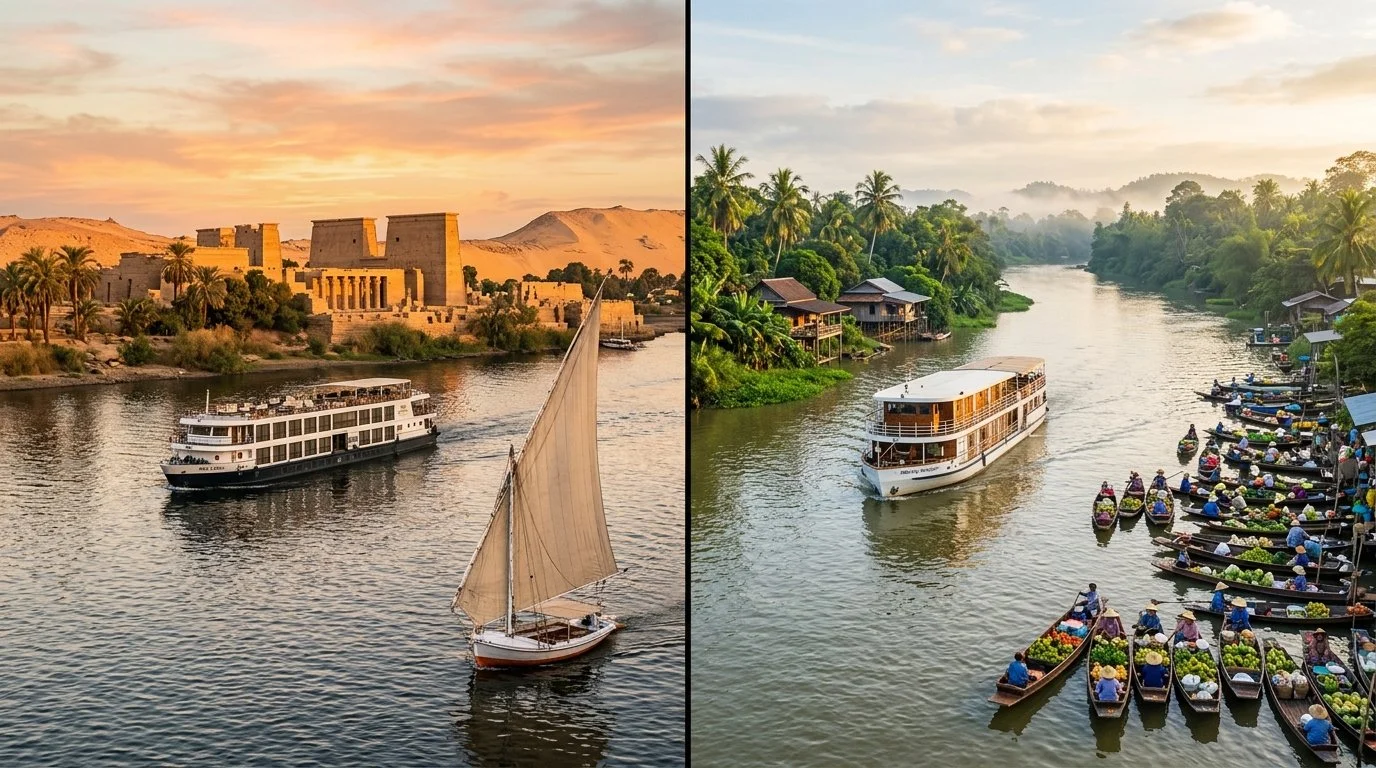
A River Ship Is Not a Small Ocean Ship
This is the most common misread, and it shapes everything else. An ocean ship is a destination in its own right — the days at sea are part of the product. A river ship is transport with excellent hospitality attached. You are docked nearly every day, frequently within walking distance of the site itself, and the vessel is a place to sleep, eat well, and decompress between encounters rather than a resort you happen to be staying in.
That trade has consequences. Staterooms are smaller. There is no casino, no waterslide, no third theater. Guest counts run in the dozens rather than the thousands, which means the dining room becomes familiar by the second night and the crew learns your coffee order by the third. What you gain is proximity — the single most underrated luxury in travel. You also gain flat water. If motion sickness has kept you off ships entirely, a river is where you find out that the problem was never boats.
The Nile: Where the Itinerary Is the Archaeology
The classic Nile voyage runs between Luxor and Aswan, typically three to seven nights, and the sequence barely varies because the sites barely move: Karnak and the Valley of the Kings at the Luxor end, the temples at Edfu and Kom Ombo along the way, Philae near Aswan. Ships tie up within sight of several of them. You walk off the gangway and into a temple complex, which is a very different experience from a coach transfer and a queue.
Season matters more here than on almost any other itinerary in the world. October through April is the civilized window. June through August is genuinely punishing, and no amount of thoughtful planning makes standing in an unshaded courtyard at midday in an Egyptian summer pleasant.
One insider note: build the Abu Simbel extension in before you finalize anything. It sits well south of Aswan and is reached by air or road, the pre-dawn departure is the whole point, and the good arrangements sell through early. The difference between arriving at first light and arriving at ten o’clock is the difference between a private audience and a crowd.
The Mekong: Where the Itinerary Is the Everyday
The Mekong runs the other way entirely. Most voyages connect the Ho Chi Minh City area with Phnom Penh and continue toward Siem Reap, generally seven or eight nights, crossing the Vietnam–Cambodia border mid-voyage. Angkor bookends the trip, but the river itself is not about monuments. It is about life happening at water level: floating markets, stilt villages, silk weavers, brick kilns, monks collecting alms at dawn.
Water level is the planning variable nobody mentions. In the higher-water months — broadly late summer into autumn — ships travel farther and more of the itinerary happens by water. In the drier months, more of it happens by coach. Neither is wrong, but they are not the same trip, and the brochure photograph was taken in one of them.
Our recommendation nearly every time: add two land nights in Siem Reap at the end rather than the beginning. Angkor deserves more than a shore excursion, and seeing it after a week on the river rather than before completely changes how you read it.
The real question is not which river is better. It is which rhythm suits you. The Nile is shorter, denser, hotter, and more structured — heavy on guided site visits and Egyptology, and satisfying in about a week. The Mekong is longer, slower, more humid, more improvisational, and genuinely wants two weeks once you account for the land portion and the flights to get there.
Then there is cabin selection, which matters far more on a small ship than a large one. There are only a handful of the best rooms on a vessel that carries a few dozen guests, and they are gone first. Add visa requirements, internal flights, single supplements, and pre- and post-night hotels, and the file gets complicated quickly — which is the honest argument for not building either of these on your own.
Both regions operate under legal and cultural norms that differ meaningfully from South Florida, and that is precisely the kind of detail that belongs in a planning conversation rather than a search result. For our LGBTQ+ clients we walk through it plainly and specifically — hotel selection, ground handlers we have vetted, guide pairing, where discretion is a practical consideration and where it simply is not a factor. No lectures and no scare copy. Accurate, current, specific information, so the decision stays yours and the trip is comfortable once you are in it. On these two itineraries, that conversation is the most valuable thing we do.
The rest is leverage. Wilton Vida Group is a Travel Leaders Network affiliate, which puts advisor-access inventory, amenity packages, and real supplier relationships behind your booking at no added cost to you. It also means one person holds the entire file — the sailing, the flights, the Abu Simbel morning, the Siem Reap nights, the transfers, and the small things that decide whether a complicated trip feels effortless.
Ready to start planning? Reach out to our team at wiltonvida.com or connect with us on WhatsApp at https://wa.me/message/YUIL7UEHTZDAM1 — we will build the version of this that fits how you actually like to travel.
Hablamos español, y con gusto los acompañamos en cada paso del camino.