Signed, Sealed, Delivered: How Combined Notary and Courier Service Streamlines Your Closing
The signing finished at 2:40. The documents reached the title company at 11:15 the following morning. Nothing went wrong in between — that is the point. Nine hours of nothing happening is what a normal handoff looks like, and in a closing, nothing happening is a cost.
Firms and title companies in South Florida have generally optimized the signing itself. The signer is vetted, the package is right, the appointment holds. What has not been optimized is the gap that opens the moment the last signature dries: who physically has the documents, where they are going, and how long they sit before they get there.
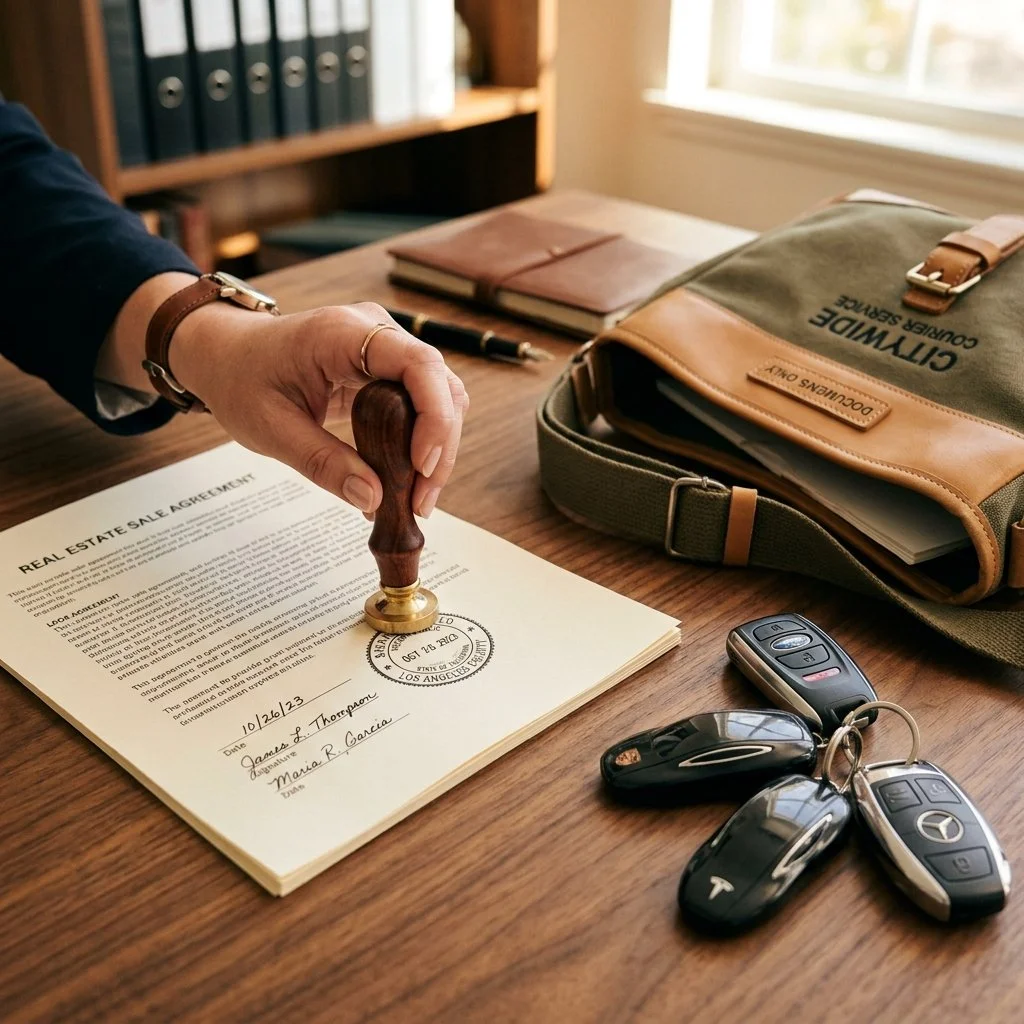
The gap nobody owns
Trace a conventional workflow. A mobile notary completes a signing at a kitchen table in Coral Springs at four in the afternoon. The notary’s engagement ends when the package is complete. The documents now need to reach a title office in Fort Lauderdale, a lender’s processor, and occasionally the county recorder. Somebody has to move them.
In practice, that somebody is one of three options, each with its own failure mode. The signer is asked to drop the package at a shipping location, which introduces a party with no professional obligation and no chain of custody into the handling of executed originals. A courier is dispatched separately, which means a second scheduling conversation, a second vendor, and a window that rarely aligns with when the signing actually ended. Or a paralegal drives, which is a solution that works until the day it costs you a billable afternoon.
All three produce the same result: the documents come to rest. And executed originals at rest are the most expensive form of idle inventory a closing has, because every downstream step — funding, recording, disbursement — is waiting behind them.
What “one motion” actually means
Combining the two functions is less clever than it sounds and more effective than it sounds. The same credentialed professional who conducts the signing takes custody of the completed package and delivers it. The engagement does not end at the signature; it ends at the destination.
The practical effects compound. A single scheduling conversation replaces two. There is no interval during which the documents are unattended or in the hands of a party outside the transaction. Chain of custody runs unbroken from execution to delivery, documented by one person who was present for both ends of it. And the delivery window is knowable at the time of booking rather than negotiated afterward, which is what actually lets a closing coordinator plan the rest of the day.
The time recovered is usually most of a business day. That is not a rounding error in a rate-lock window or a same-day funding scenario.
Why chain of custody is the real argument
Speed is the reason people call. Custody is the reason it matters.
Executed originals carry legal weight that copies do not. A misplaced package in a real estate closing is not a document problem, it is a title problem, and it surfaces at the worst possible moment — sometimes years later, during a subsequent sale. Every additional handoff in a document’s path is another point at which custody becomes undocumented, and undocumented custody is exactly what nobody can reconstruct when it is questioned.
A combined engagement reduces the handoffs to the minimum the transaction allows. One professional, one custody record, one signature on the delivery confirmation. That is a materially better evidentiary position than a package that passed through a retail counter and a sorting facility, however reliably those usually work.
There is also a confidentiality dimension worth stating plainly. Closing packages contain Social Security numbers, account numbers, and full financial pictures. Handling them under a professional obligation is different from handling them under a shipping company’s terms of service.
Where this fits best
Not every transaction needs it. A routine signing with a comfortable timeline and a package that can travel by overnight service does not require anyone to reinvent the workflow.
The cases where combined service earns its keep are the compressed ones. Same-day or next-day funding. A rate lock expiring inside seventy-two hours. A signer who is out of state, hospitalized, or in a facility, where the appointment window is fixed by someone else’s schedule and every hour afterward is borrowed. Multi-party signings where the parties are in different counties and the package has to be assembled before it can move. Recording deadlines where the difference between a Friday afternoon and a Monday morning delivery is three days of accrued interest and a very uncomfortable phone call.
For firms and title companies handling volume, the version that pays is standing coverage rather than transaction-by-transaction booking — a known provider, known rates, and a scheduling relationship that does not require a fresh negotiation at four in the afternoon.
Working with Wilton Vida
Wilton Vida Group provides mobile notary and document courier services across Broward, Miami-Dade, and Palm Beach counties. Christopher is an NNA Certified Signing Agent, background screened, which is the credentialing standard title companies and lenders generally look for on loan signings and real estate closings — it means the signing itself is conducted by someone trained on closing packages, not simply by someone holding a commission.
That credential is the reason the combined model works. Taking custody of an executed closing package is a responsibility, not a delivery task, and it should sit with someone whose vetting the receiving party can verify independently. Our Signing Agent status is verifiable through the National Notary Association’s directory if your compliance team requires documentation on file.
For firms who work with us regularly, we recommend establishing coverage terms before you need them. The transactions that most need same-motion service are exactly the ones where there is no time to onboard a vendor.
A brief note on scope: Wilton Vida provides notarial and courier services. We do not draft documents, advise on their contents, or practice law, and nothing here is legal advice. Notarial acts are performed under Florida Statutes Chapter 117.
Gracias por su confianza — estamos a sus órdenes.
Need signing and delivery handled as one engagement? Reach out to our team at wiltonvida.com or connect with us on WhatsApp at https://wa.me/message/YUIL7UEHTZDAM1