Panama Canal Cruises That End in Fort Lauderdale
Most people choose a cruise by where it starts. For a Panama Canal transit, the more consequential question is where it ends — because a one-way passage that disembarks at Port Everglades removes the return flight entirely, and for anyone living between Palm Beach and Miami, that changes the shape of the whole trip.
Why the Ending Port Matters More Than the Starting One
A full Canal transit is, by its nature, a repositioning voyage. The ship enters one ocean and leaves through another; it cannot simply return to where it began. That means every full transit lands its guests somewhere other than the port they boarded from, and the two ends of that route are almost always the U.S. Pacific coast and Florida.
If you live in South Florida, the eastbound version of that voyage is quietly the better product. You fly one way, out to the Pacific coast, and you come home by sea. There is no post-cruise airport at the end of two or three weeks at sea, no connection to make with luggage, no fare to buy in the direction that always costs more because everyone else is flying it too. You disembark at Port Everglades and you are twenty minutes from your own driveway.
Westbound is the mirror image and works beautifully for anyone who wanted a reason to end up in California anyway. But if home is here, the arithmetic favors arriving.
Full Transit and Partial Transit Are Not the Same Trip
This is the single most common misunderstanding, and it is worth being clear about because the two itineraries are marketed with similar language and are not similar experiences.
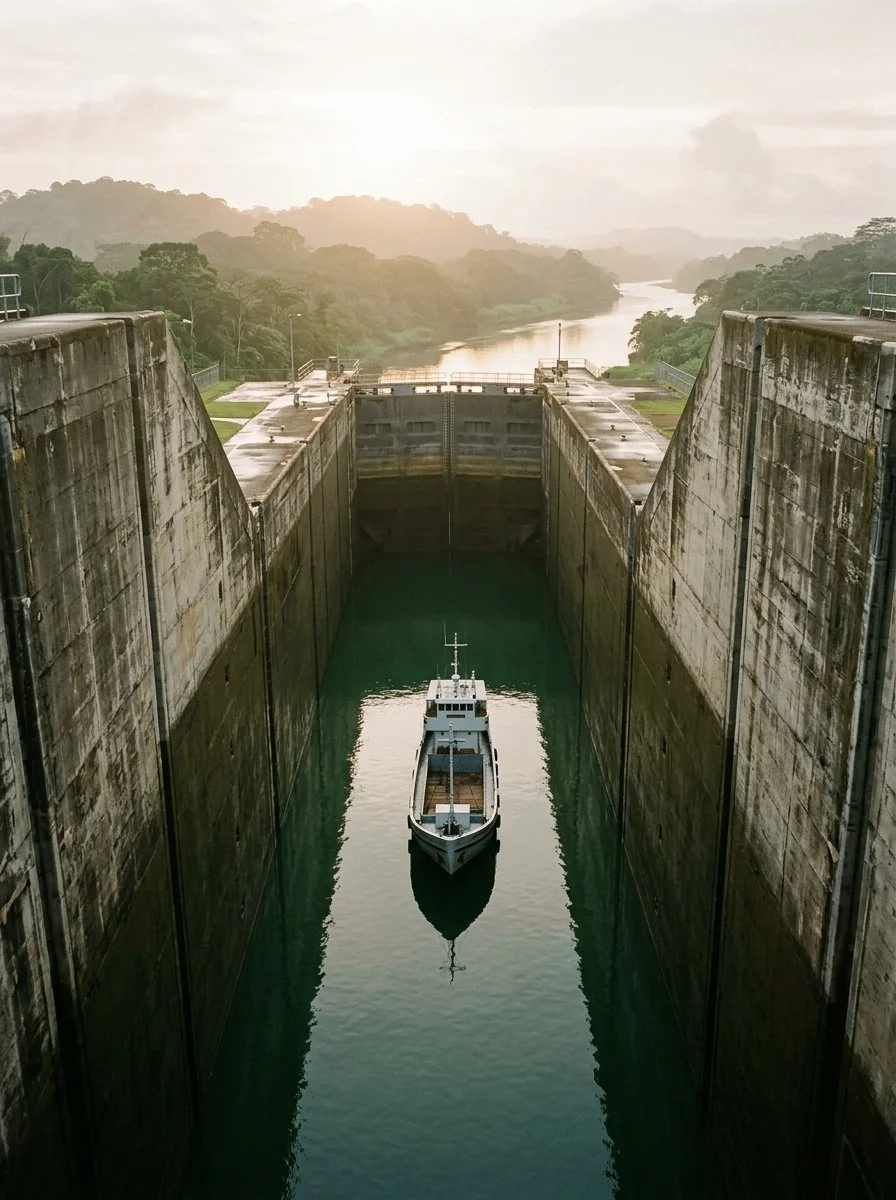
A full transit crosses the isthmus ocean to ocean. The ship passes through the locks on the Pacific side, crosses Gatun Lake — the enormous man-made reservoir that supplies the water the entire system runs on — and descends through the Atlantic-side locks into the Caribbean. Depending on the ship’s dimensions, that happens through the original Panamax chambers or the newer, larger Neopanamax locks, and the two are visibly different pieces of engineering.
A partial transit enters from the Atlantic side, ascends into Gatun Lake, and then comes back out the way it came. These are the round-trip itineraries that sail from Fort Lauderdale and return to Fort Lauderdale. They are shorter, they are cheaper, and they are a genuinely good product — but you have not crossed anything. You have visited.
Neither is wrong. They are simply different purchases, and the brochure copy does not always make that obvious.
Direction, Season, and Why Both Are Fixed
The Canal seasons are dictated by where the ships need to be. Vessels reposition out of Alaska and the Pacific coast in the autumn, heading for a Caribbean winter — those are the eastbound transits that end in Florida, and they cluster from roughly September through November. In spring, the fleet goes the other way, and the westbound transits out of Florida run through March, April, and May.
Lengths vary widely. Shorter passages run around eleven days between Fort Lauderdale and a Pacific-side Panamanian port. Full ocean-to-ocean voyages typically run fourteen to twenty-two days depending on how many Central American and Caribbean calls are folded in, and several lines run longer programs that add Colombia, Costa Rica, and the Mexican Riviera.
The practical consequence: there is no browsing this category year-round. The inventory exists in two narrow windows, and the desirable cabins on the best ships are committed long before either window opens.
What the Day in the Locks Is Actually Like
It is slow, and the slowness is the point. Transit day begins before dawn — the approach into the first chamber is usually first light — and the ship spends the better part of eight to ten hours moving through a system that has not fundamentally changed its logic in a century. You watch the chamber fill. You watch the walls descend past the balcony. You watch a vessel in the parallel lane doing precisely the same thing forty feet away.
The best vantage points are not always the ones you would guess. Forward observation decks fill early. A high aft balcony often gives a better view of the chamber closing behind you, which is the more dramatic half of the process. Plan the day the way you would plan a scenic rail journey rather than a port day.
Landing at Port Everglades
Port Everglades sits at 1850 Eller Drive, roughly five miles from Fort Lauderdale-Hollywood International — which matters mostly for the guests you may be bringing with you who do have a flight to catch. For local travelers, disembarkation is simply a car ride, which after three weeks at sea is a genuinely different feeling from the alternative.
Wilton Vida Group is based in Wilton Manors, and this is our home port. Through Travel Leaders Network we hold advisor access to the cabin inventory and supplier programs that sit behind the public booking flow — and on a category this seasonally constrained, access is most of the value. We also plan the front half properly: the one-way flight out, the pre-cruise night that protects you from a delay, and the direction that makes sense for how you actually want the trip to feel.
Let’s Get You on One
If a Canal transit has been on the list, the useful conversation is about which direction and which season, not which ship. Reach our team at wiltonvida.com or message us on WhatsApp at https://wa.me/message/YUIL7UEHTZDAM1.
Un cruce inolvidable, de océano a océano. Le esperamos.