Q1 Offsite Planning: Why January Venues Get Booked in October
Leadership decides on a January kickoff sometime in early December. By then the meeting space worth having is contracted, the room block is priced for late demand, and the executive assistant who inherits the project is negotiating from the weakest possible position. The offsite that runs smoothly was contracted in October. This is not a failure of enthusiasm. It is a failure of calendar.
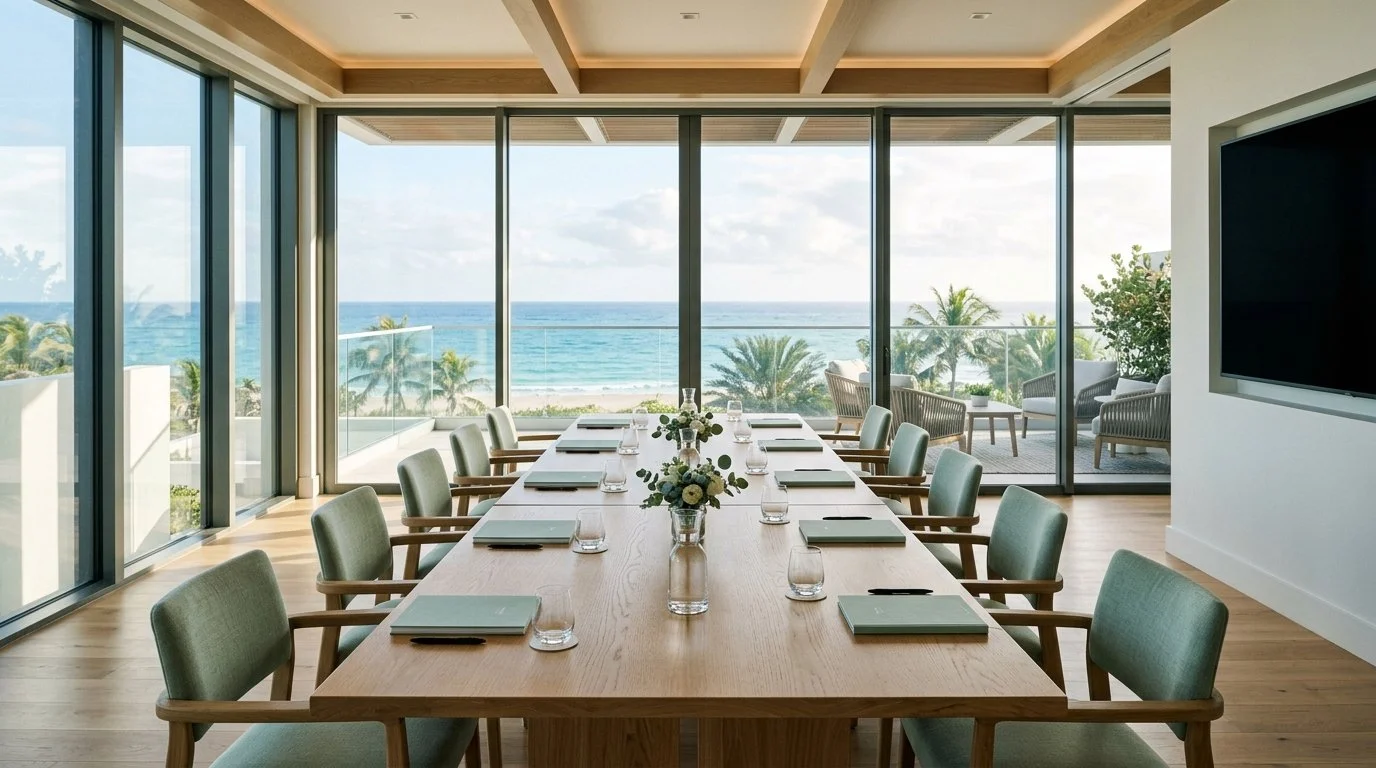
Why January is harder than it looks
The first six weeks of the year are the densest corporate meeting window in the United States. Sales kickoffs, annual planning, board meetings, and industry conferences all compress into the same period, and they compete for the same inventory. In warm-weather markets the problem doubles, because January is also peak leisure season. A South Florida property in late January is selling the same rooms to a company and to a family from Toronto, and the family booked in September.
The practical effect is that lead time is worth more than budget. A group with ninety days of notice and a flexible date will get a better outcome than a group with thirty days and more money, because at thirty days the answer is frequently that the space does not exist at any price.
Decide the shape before the destination
The most common planning error is starting with the location. Start instead with three answers: how many people, how many nights, and what has to be true at the end of it. An offsite designed to align a leadership team of twelve is a completely different property brief from a kickoff that has to energize a hundred and forty people in a general session. One needs a boardroom, good food, and quiet. The other needs a room with a stage, reliable bandwidth, and breakout space adjacent rather than three floors away.
Answer those three first and the venue shortlist writes itself, which is where a Wilton Vida brief begins. Answer them after the contract is signed and you discover the general session room has a support column in the middle of it.
The contract terms that actually matter
Rate is the term that gets negotiated and the least consequential one. The terms that decide whether an offsite is financially safe are attrition, cancellation, and the food and beverage minimum.
Attrition is the percentage of the room block you are obligated to fill. Contract eighty rooms, fill fifty, and the difference may be billable. Blocks should be built to the number confidently expected, not the optimistic number, with an added-rooms clause to expand if attendance grows. Expanding is easy. Shrinking is expensive.
Cancellation should be a sliding scale tied to dates, and it should be read closely, because the liability at sixty days is often dramatically higher than at ninety. The food and beverage minimum is the third trap: a minimum set high enough to justify a discounted room rate can force a company into a plated dinner it did not want in order to avoid paying for food it will not eat. Negotiate the minimum down, or negotiate what counts toward it.
Where budgets leak
The line items that blow an offsite budget are rarely the ones on the proposal. Audiovisual is the largest, and in-house providers frequently price at a multiple of market. Ask early whether outside AV is permitted and what the facility fee is if so. Service charges and taxes on food and beverage can add a third or more to the quoted figure, and a proposal that quotes pre-tax is not a proposal, it is a starting point.
Ground transportation is the quieter one. A hundred and forty people arriving into two airports across a six-hour window is either a coordinated transfer plan or an unbudgeted stream of individual expense claims. The first costs less and starts the event better.
The timeline that works
At roughly one hundred and twenty days out, fix the dates and the headcount range, and put the destination shortlist together. At ninety days, tour or review properties, collect proposals, and negotiate. Contract at eighty to ninety days. At sixty days, open registration and issue travel instructions, because the room block only protects you if people actually book into it. At thirty days, confirm the final agenda, AV requirements, dietary needs, and transfer manifest. The last two weeks should be confirmation, not construction.
Teams that compress this into six weeks can still produce a good event. They pay more for it, and the person running it does not enjoy it.
What Wilton Vida brings to it
We handle corporate offsites as a managed program rather than a series of bookings, which means one contracted point of accountability for venue, air, ground, and rooming. Through Travel Leaders Network we access group rates and partner concessions that are not available through a direct inquiry, and our Marriott Platinum Elite standing carries real weight in negotiation and in the details that make attendees feel looked after on arrival.
Just as importantly, we read the contract before you sign it and tell you where the exposure sits. An attrition clause is easy to accept and expensive to discover. That review costs nothing and has saved clients more than our fee on a single event.
Gestionamos eventos corporativos bilingües, con comunicación clara para todo el equipo.
If a Q1 offsite is on the horizon and nobody has started, now is the moment. Reach our team at wiltonvida.com or start a conversation on WhatsApp at https://wa.me/message/YUIL7UEHTZDAM1.