Both of them put you in Europe. That is where the similarity ends.
A river voyage and an ocean crossing are sold from adjacent pages of the same brochure, priced within reach of each other, and described with almost identical vocabulary. They then hand you two entirely different vacations. One trades range for depth. The other trades depth for range. Neither is the upgrade — but one of them is wrong for you, and it is usually possible to work out which before you book rather than on day three.
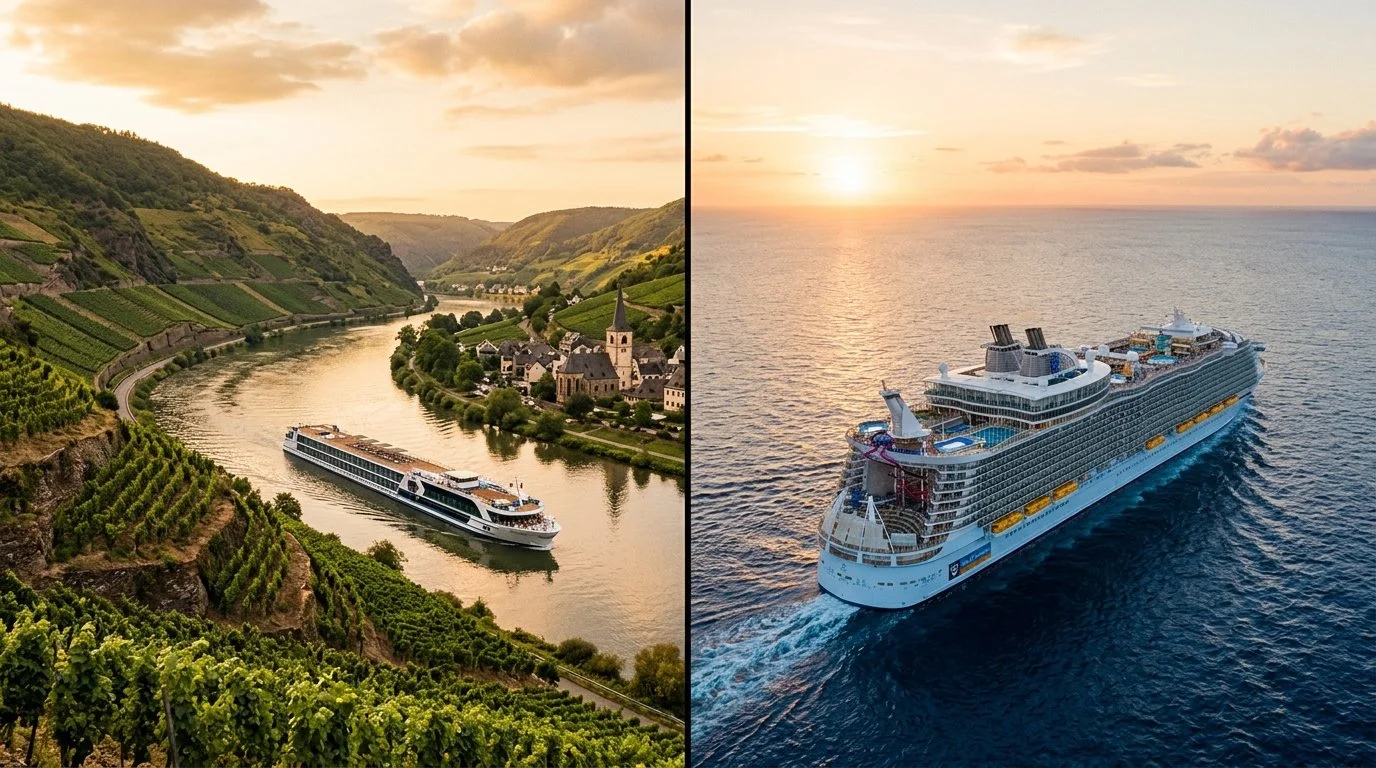
The Ship Decides Everything Downstream
Start with the vessel, because every other difference follows from it.
A European river ship is built to a hard constraint: it has to fit through locks and under bridges on the Rhine, the Danube, the Douro, the Seine. That caps length, width and height, which caps passenger count at somewhere around one hundred and fifty to two hundred people. You will recognize faces by the second day. There is one restaurant, one lounge, a sun deck, and that is broadly the ship.
An ocean vessel operating European itineraries has no such ceiling. It carries anywhere from a few hundred guests on a small luxury ship to several thousand on a mainstream one, with multiple dining rooms, theaters, spas, pools and entertainment programming. The ship is a destination in its own right, deliberately.
That single structural difference cascades into everything: how you spend a day at sea, how long the buffet line is, whether you can get a table without a reservation, and whether the trip feels like a floating village or a floating small town.
What a Day Actually Looks Like
On a river itinerary, the ship docks in the center of town. Not at a container terminal twenty minutes out — in the middle of it, frequently within walking distance of the cathedral. You step off the gangway into Bamberg or Vienna or Porto. Many rivers ships sail overnight and stay in port all day, which means you can go ashore in the morning, come back for lunch, and go out again after dark for a concert or a wine bar.
Ocean itineraries operate differently. Ports are further apart, so a percentage of your days are sea days, and the cruise line fills those days deliberately with programming. Port calls tend to run a set window — often eight to ten hours — and larger ports frequently sit outside the historic center, so a shore excursion or a taxi becomes part of the equation. On the other hand, an ocean itinerary can put you in Barcelona, Palma, Rome and Santorini on a single week, which no river can.
The blunt version: rivers give you more time in fewer places. Oceans give you more places with less time in each.
Who Each One Actually Suits
River cruising is the right answer for travelers who want the destination and not the vessel. It suits people who like to walk out of a ship and into a town, who value unpacking once while covering a region, who prefer a small and stable group of fellow travelers, and who genuinely enjoy the deliberate, quiet pace of watching a valley go by from a deck chair. It is also unusually strong for multigenerational family groups and for solo travelers who want a social environment that is not overwhelming.
Ocean cruising is the right answer for travelers who want variety and options. It suits people who want choices at dinner, entertainment after it, and the ability to have a completely different day than their travel companion. It suits families with children and teenagers, who need programming the ship provides and the river does not. And it suits anyone whose Europe list spans coastlines that no river connects.
There is one more group worth naming: travelers who are not sure they will like cruising. An ocean ship gives you somewhere to go if the format does not click. A river ship does not, and that is worth weighing honestly.
The Practical Differences Nobody Mentions
Three that matter more than most travelers expect.
River water levels are real and occasionally disruptive. Unusually low or high water on the Rhine or the Danube can force a ship to swap itinerary segments or move guests by coach for a stretch. Reputable operators handle it well and it is not common, but it is a genuine variable that ocean itineraries do not have.
River pricing is more inclusive on its face. Shore excursions, most beverages, gratuities and airport transfers are frequently bundled. Ocean pricing more often starts lower and builds through add-ons. Comparing the headline number of one against the other is meaningless; comparing the all-in totals is the only useful exercise.
And accessibility differs. River ships are small, which sometimes means limited elevator coverage and gangways that shift with the water level. Ocean vessels are generally better provisioned for mobility needs. If that applies to anyone in your party, it should be an early question rather than a late discovery.
How Wilton Vida Approaches the Choice
We do not start by asking which one you want. We start by asking what you want your third day to look like — whether you would rather be walking a market square in a town you had not heard of, or standing on a balcony somewhere between two famous ones.
The answer to that question usually settles it in about a minute, and everything after is logistics: which operator, which season, which cabin category, which pre- and post-nights make the flights survivable. Our Travel Leaders Network affiliation gives Wilton Vida direct supplier relationships and negotiated access across both categories, so the recommendation is never constrained by what one line happens to be pushing.
Tell Us Which One Sounds Like Your Week
Read both descriptions again. One of them probably felt like a relief and the other like work. That is the answer, and we can build the rest around it.
Reach out to Wilton Vida at wiltonvida.com or connect with us on WhatsApp at https://wa.me/message/YUIL7UEHTZDAM1.
¿Río u océano? Dos maneras muy distintas de conocer Europa — le ayudamos a elegir, en inglés o en español.
Wilton Vida Group LLC — Licensed Seller of Travel, Florida ST #TI122511