Southeast Asia Small-Ship Cruising, Explained
Southeast Asia doesn’t reveal itself from a highway or a tour bus window. It reveals itself from the water — the Mekong Delta’s floating markets, Halong Bay’s limestone karsts rising straight out of the sea, coves in eastern Indonesia that no road actually reaches. Small-ship cruising through the region isn’t a novelty booking; for a lot of this part of the world, it’s genuinely the best way to see it.
Why Small Ships Fit This Region Specifically
Southeast Asia’s most compelling scenery tends to sit in places large vessels simply can’t reach — narrow river channels, shallow coastal waters, and harbors too small for anything beyond a few hundred passengers. A small ship, typically carrying anywhere from a few dozen to a couple hundred guests, can navigate the Mekong’s narrower stretches, tuck into Halong Bay’s karst formations overnight, or anchor off a remote Indonesian island that a mainstream cruise ship would sail straight past. The region essentially selects for small-ship travel — it’s not a stylistic choice so much as a practical one.
The Mekong Delta
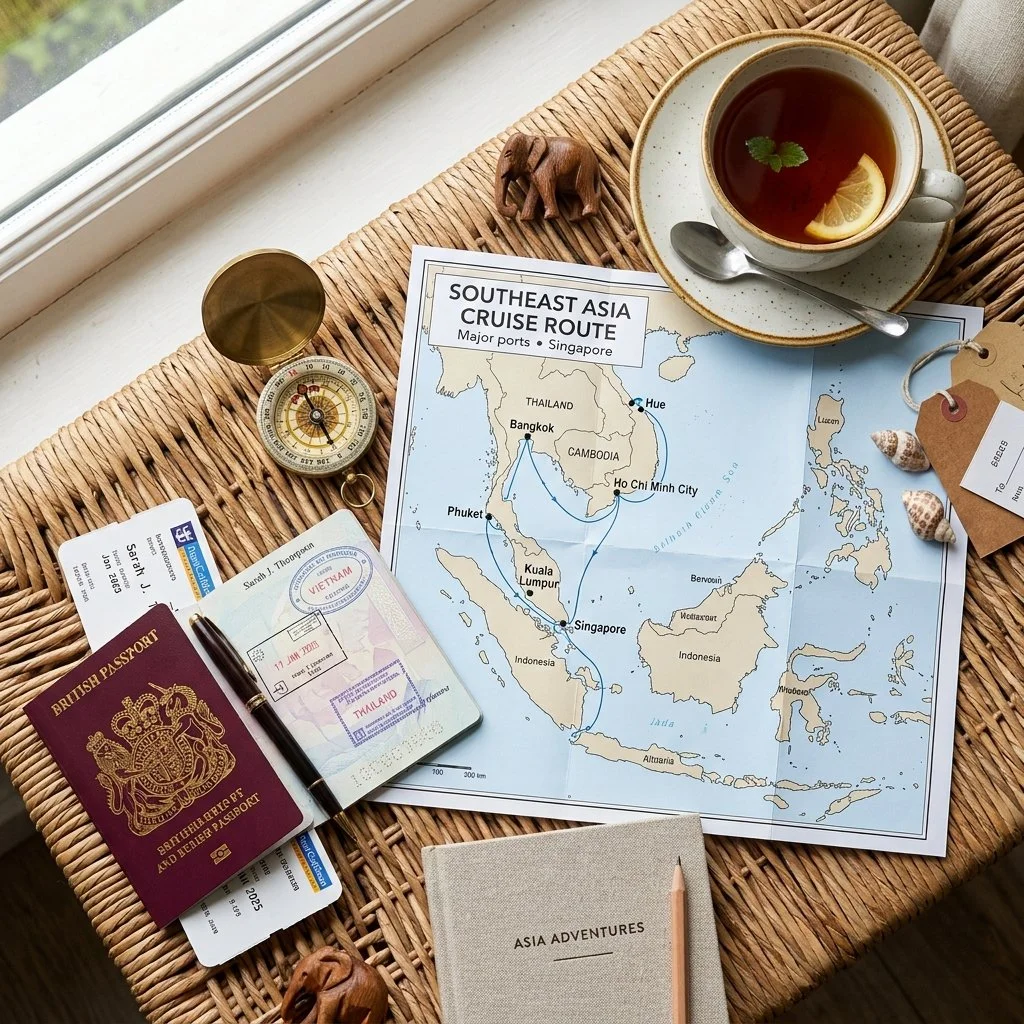
A Mekong river cruise, typically running between Ho Chi Minh City and Siem Reap (or the reverse), moves through Vietnam and Cambodia along one of Southeast Asia’s great waterways. Floating markets, riverside villages, and the temples of Angkor at the journey’s end make this one of the most culturally dense small-ship itineraries anywhere in the world — days built around genuine local life rather than curated tourist stops.
Halong Bay and Vietnam’s Coast
Vietnam’s coastline offers a completely different small-ship experience: Halong Bay’s thousands of limestone karsts rising out of emerald water, explored overnight aboard traditional-style junk vessels built specifically for the bay. It’s a shorter, more scenic-focused sailing than the Mekong — often two to three nights — and pairs naturally with a longer Vietnam land itinerary before or after.
Indonesia’s Far-Flung Waters
Further south and east, small-ship expedition cruising through eastern Indonesia — the waters around Komodo National Park and the remote Raja Ampat archipelago — opens up some of the richest marine biodiversity on the planet. These itineraries lean more expedition than cultural, built around snorkeling, diving, and wildlife (Komodo dragons among them) rather than riverside villages, and typically run on smaller expedition-style vessels than the river-based Mekong sailings.
What to Expect Onboard
Small-ship Southeast Asia itineraries generally run more casual and excursion-heavy than a typical ocean cruise — days are built around shore time and cultural immersion rather than onboard amenities, cabins tend toward comfortable rather than opulent, and the pace favors depth in fewer places over a packed port-a-day schedule. Travelers coming from a big-ship ocean cruise background should expect a genuinely different rhythm, not a scaled-down version of the same trip.
Choosing the Right Itinerary
The Mekong, Halong Bay, and Indonesia’s outer islands are three genuinely different trips wearing the same “small-ship Southeast Asia” label — one culturally immersive, one scenic and compact, one wildlife- and expedition-focused. Matching the right one (or combining two into a longer trip) to what a traveler actually wants out of the region is where the real planning value sits, and it’s exactly the kind of itinerary design an advisor earns their keep on.
Curious which corner of Southeast Asia fits your travel style? Reach out to our team at wiltonvida.com or connect with us on WhatsApp at https://wa.me/message/YUIL7UEHTZDAM1.
Para nuestros clientes de habla hispana: podemos ayudarle a planificar su crucero en barco pequeño por el sudeste asiático en español.