You are in Madrid, Lisbon, or Lima, and a Florida closing needs your signature by Friday. The old answer was a consulate appointment three weeks out. The current answer is a Florida notary on a video call tonight.
Florida law lets this happen, and it is more permissive than most people expect. It also has one trap that catches couples and families almost every time. Here is how it actually works.
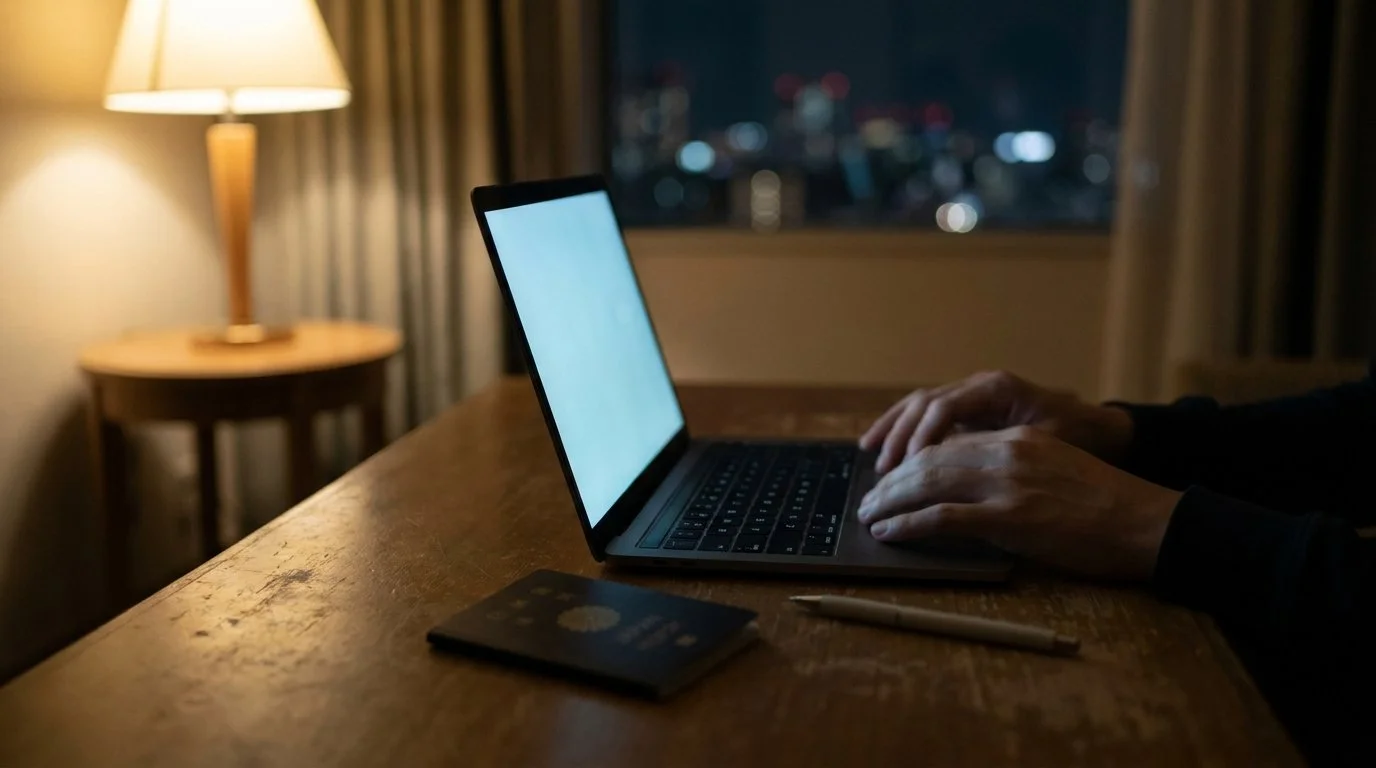
The notary has to be in Florida. You do not.
This is the whole architecture in one sentence. Florida Statute 117.265 requires the commissioned online notary to be physically located in Florida at the moment of the act. It places no such requirement on you. The statute says the notarization is valid regardless of whether the principal or any witnesses are physically located in this state at the time of the online notarization.
Not in the state. Not in the country. You can be in a hotel in Bangkok at two in the morning, and if the notary is sitting in Wilton Manors, Florida, the act is a Florida act.
The statute goes further and says the notarization is deemed to have been performed within this state and is governed by the applicable laws of this state. That matters for the document. It means the signature is evaluated under Florida rules, not the rules of wherever you happened to be standing.
There is a consent step, and people skip it
Because the law is reaching across a border to govern your signature, it asks you to agree to that first. Section 117.265 requires that when the principal is not located in Florida, the notary must confirm, either verbally or through written consent, that you want a Florida notary and want Florida law to apply.
In practice it is a short exchange near the top of the session. It is also the part a rushed notary clips, and a clipped consent is a defect someone can point at later. If your session does not include it, that is a signal about who you hired.
Your foreign passport works
Identity proofing is where most remote sessions stall, and signers abroad often assume they are disqualified before they start. They usually are not.
Florida built a path for exactly this situation. Section 117.201 provides that a foreign passport without a United States immigration stamp can verify identity specifically for an online notarization of a principal not located within the United States. The document that would be a problem at a domestic signing is the document the statute names for an overseas one.
What still has to work is the technology side: a stable connection, a camera good enough to capture the credential clearly, and a quiet space where you can be heard. Those fail far more often than identity does.
The trap: your witnesses cannot be abroad
Here is the asymmetry that catches people. The signer can be anywhere on earth. A remote witness cannot.
Section 117.285 requires a witness appearing remotely to verbally confirm that he or she is a resident of and physically located within the United States at the time of witnessing. There is no overseas exception written into it.
So the couple living in Barcelona who plan to have her brother in Valencia witness the signing have a problem, and they usually discover it with the session already open and the clock running. If your document needs witnesses, line up people inside the United States before you book. For wills in particular, Florida layers in further requirements when fewer than two witnesses are physically present with the signer, which is a conversation to have before the appointment rather than during it.
What to settle before you book
Three questions, answered in advance, prevent nearly every failed overseas session.
First, does this document require witnesses, and if so, do you have people located in the United States who can join. Second, what is the receiving party — the lender, the court, the county recorder, the foreign ministry — actually going to do with a Florida electronic notarization, and have you asked them rather than assumed. Third, what time is it where you are, because a session scheduled for Florida business hours lands in the middle of your night, and tired signers make the mistakes that end sessions early.
What the notary has to do at their end
Worth knowing what you are paying for, because the Florida side of an overseas session is not passive.
The notary has to be physically in Florida and has to be able to demonstrate it. They have to run the identity proofing to the standard the statute sets, capture the consent, conduct the act on an audio-video platform that meets Florida's requirements, apply a tamper-evident electronic seal, and retain the journal and recording for ten years under section 117.245.
None of that changes because you are in a different hemisphere. What changes is the scheduling, the connection quality, and the identity path, and those are the three things a competent notary will want to test with you before the appointment rather than discover during it.
Wilton Vida runs these sessions for clients scattered across time zones, and the preparation call matters more than the signing. We will tell you before you pay whether your document can be done this way, whether your witness plan survives the statute, and what the realistic turnaround looks like from where you are sitting.
If you are abroad and a Florida document is waiting on you, reach out at wiltonvida.com or message us on WhatsApp at https://wa.me/message/YUIL7UEHTZDAM1. Tell us the document and your location, and we will tell you straight whether this works.
Estamos aquí para acompañarte en cada paso del camino.