Notary Fraud in the Age of AI: Your Three-Step Defense
AI Fraud Is Changing the Game
Human Verification Remains the Ultimate Firewall
The Problem: AI Fraud Is Changing the Game
The digital landscape is shifting rapidly, and unfortunately, so is fraud. While artificial intelligence (AI) offers exciting possibilities, it has also introduced sophisticated new tools for malicious actors. We are now in the age of AI Notary Fraud, where scammers can use technology, like deepfakes and advanced voice manipulation, to pose as individuals they are not.
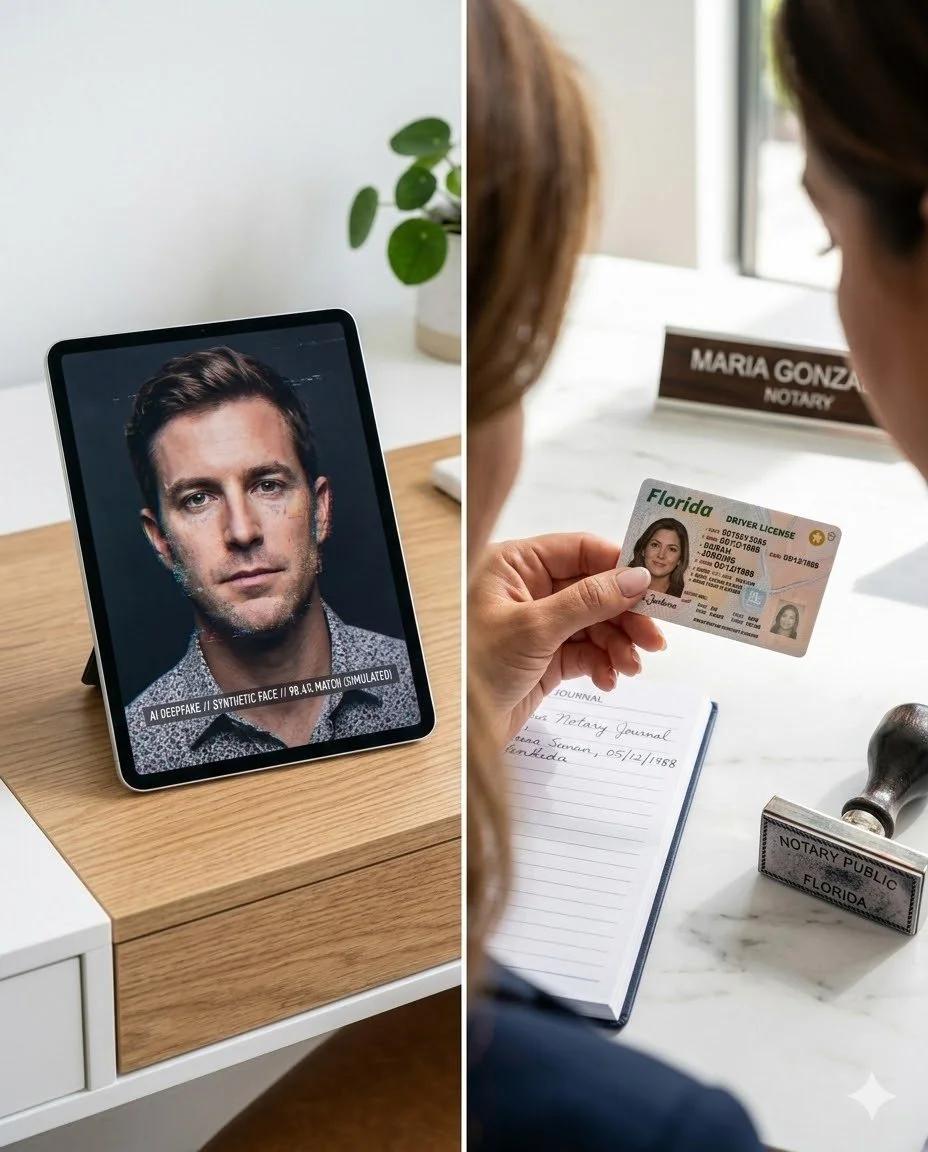
Think of a hypothetical scenario: A client thinks they are video conferencing with their business partner, discussing a high-stakes contract. On the screen, the partner looks and sounds perfectly normal. The conversation flows logically. The client, feeling secure, moves forward with a significant financial transaction, only to discover later that the entire interaction—including the "video call" and "voice"—was a sophisticated AI deepfake.
This is the frightening reality of the new "AI fraud" landscape. Traditional methods of verification, relying solely on visual or auditory confirmation in a digital space, are no longer foolproof. The threat is real, and it’s growing.
The Solution: Human Verification Remains the Ultimate Firewall
In a high-risk tech world, the answer isn’t more complex software; it’s the oldest security system of all: human verification. This is why the role of a licensed, trained Notary Public remains absolutely critical in 2026.
We are your ultimate firewall. AI can manipulate data and forge digital inputs, but it cannot (yet) effectively fake the nuanced physical reality of a real person in real time. Human verification is the only reliable defense against the deepfake era.
Wilton Vida's Three-Step Human-Centric Defense
As a Wilton Vida Mobile Notary, I don't just "stamp" your documents. My entire process is a structured defense, ensuring that the person signing is who they claim to be. In a high-tech world, this requires an expert "human-centric" verifier. Here is my three-step defense for every client:
1. The "Physical Reality" Check
The physical, in-person meeting is the absolute foundation of security. Scammers rely on distance and digital screens to obscure their identity. When I meet a client at their home, office, or local café on Wilton Drive, the distance is eliminated. I am not seeing a pixelated avatar; I am seeing a real person, in a real environment. I verify that they exist in physical reality.
2. The Nuanced ID Review
Digital verification often involves scanning an ID into a database. This can be bypassed by forged digital IDs or deepfake technology. My review is human-centric. I don't just scan the ID; I hold it. I check for subtle security features that a digital scan might miss. I verify the photo against the real person, the real physical entity in front of me, in real time. This level of nuance cannot be automated.
3. The "In-Real-Time" Connection
The true vulnerability of AI is its lack of spontaneity. A deepfake relies on pre-recorded or computationally predicted interactions. In a physical, in-real-time meeting, I establish a natural human connection. A fraudster in physical reality cannot replicate the fluid, spontaneous responsiveness of the actual individual. I can ask questions, engage in conversation, and verify that the interaction is a real, logical, human-to-human process, not an algorithm running a program.
Your Security, Our Priority
By prioritizing human verification in a digital world, Wilton Vida ensures that your high-stakes contracts, financial papers, and personal documents are notarized with the absolute highest level of security. You cannot automate trustworthiness.
Don't leave your most important documents to the vulnerabilities of high-tech fraud. Choose the expert, human-centric verifier.
Need to book a high-security, human-centric mobile notarization? $30 travel fee (travel + first stamp) within 3 miles of Wilton Drive through April. DM us to book! ✨