Booking a year and a half out is not a personality trait. It is not about being organized, and it is not about beating a price. It is about inventory — the plain fact that a ship has a fixed number of rooms, that the best of them are a small fraction of the total, and that they are allocated in the order people ask for them. Early booking buys you the right to choose. That is the entire argument.
Inventory Is the Whole Story
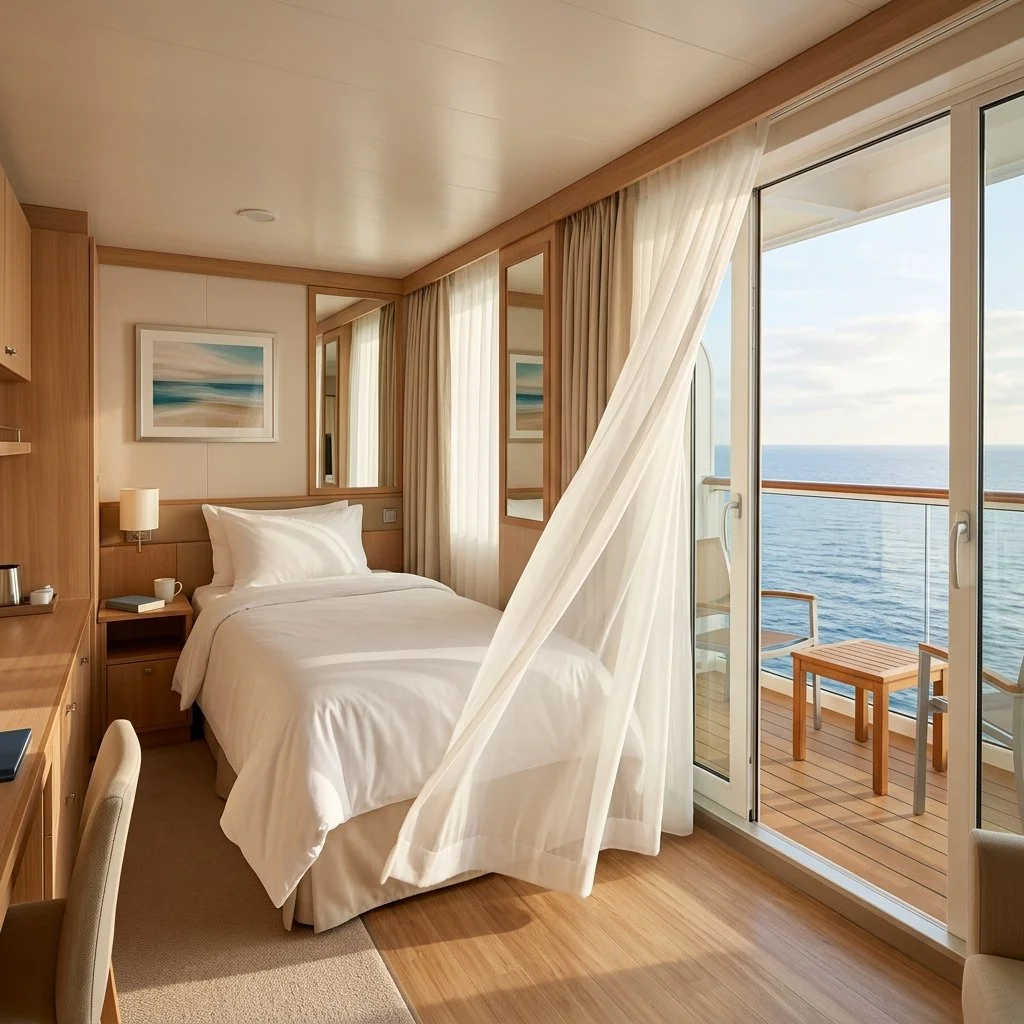
A ship is a closed system. There is exactly one owner’s suite, a handful of forward-facing rooms with the wraparound view, one deck where the aft balconies look straight down the wake, and one row of cabins that happens to sit above nothing noisy and below nothing noisy. Those rooms do not get restocked. When they are gone for a given sailing, they are gone, and no amount of flexibility on your end reopens them.
Everything else on a ship is elastic. Dining times flex, excursions add capacity, the spa opens another slot. The room does not. It is the one component of a cruise that is genuinely finite, and it is the one people leave to last.
Not All Balconies Are the Same Balcony
The category name on the deck plan tells you almost nothing. Two cabins can carry an identical designation and deliver entirely different weeks. One sits beneath the pool deck, which means chairs dragging across steel at six in the morning. One sits directly above a nightclub. One has a balcony partially obstructed by a lifeboat davit that the plan renders as a small grey shape you would never think to question. One is adjacent to a crew access door that opens and closes several hundred times a day.
There is also the question of which side of the ship the scenery is on. On an itinerary that hugs a coastline, a fjord, or a river, one side of the vessel spends the week looking at land and the other spends it looking at open water. The deck plan will not tell you which. Somebody who has sailed the route will.
This is the difference between booking a cabin and choosing one, and it is almost entirely a function of how early you ask.
The Dates Move Before the Prices Do
Most travelers watch price. Price is the noisiest signal and the least useful one this far out. What actually moves first is date availability on the itineraries that people want most — the sailings that land inside school holidays, the ones timed to a specific natural event, the departures on the shorter shoulder weeks that experienced cruisers quietly favor.
There is a second layer beneath that. The best cabins on the most desirable sailings tend to be held by repeat guests who rebooked onboard during their last voyage, before the sailing was ever released publicly. By the time a 2027 season opens to general booking, part of the good inventory has already changed hands. Booking early does not put you ahead of those guests. It puts you immediately behind them, which is a very different position from arriving nine months later.
What Early Booking Does Not Buy You
Worth being straight about this, because the opposite claim gets made constantly. Booking eighteen months out does not guarantee you the lowest fare you will ever see for that sailing. Cruise pricing moves in both directions, and a line clearing unsold inventory close-in can absolutely undercut what you paid.
The honest trade is this: you are choosing certainty over the chance of a discount. You are paying for the specific room, the specific date, and the specific itinerary rather than gambling that something acceptable will still exist when you get around to it. For a milestone trip, a multigenerational booking, or any sailing where the details are the point, that is not a close call. For a flexible traveler who genuinely does not care where they sleep or when they go, it is a real question worth asking honestly.
What early booking does reliably buy is a longer runway on everything else — deposits spread over time rather than due at once, unhurried air planning, document readiness, and the ability to make travel-protection decisions before a deadline forces one.
Deposits, Deadlines, and the Actual Risk
The exposure on an early booking is smaller than people assume. A deposit holds the room; the balance typically does not come due until relatively close to sailing, which means the money is not locked up for eighteen months. Cancellation and change terms vary meaningfully by line and by fare type, and those terms — not the headline price — are what determine how much risk you are actually carrying. Read them before you book, not after. Where a fare’s flexibility differs from the version next to it, that difference is usually worth more than the gap between them.
This is precisely the work an advisor absorbs. Through Travel Leaders Network, Wilton Vida has access to inventory, deck-level detail, and terms that are not visible on a public booking page — and, more usefully, the accumulated knowledge of which cabins on which ships are quietly worth more than their category suggests. We hold the room, we track the terms, and we watch the sailing between now and departure so that you do not have to.
If 2027 is already forming in your head as a year with a trip in it, the useful move is to start the conversation now while the ship is still mostly empty. Reach our team at wiltonvida.com, or connect with us on WhatsApp at https://wa.me/message/YUIL7UEHTZDAM1.
Un mundo. Un amor. Déjanos llevarte allí.