Green Season Safari: Why Southern Africa's Quiet Months Deserve a Look
Almost every piece of safari advice points to the dry months, when the bush thins out, the animals crowd the waterholes, and the camps run full at peak rates. It is good advice. It is also incomplete. The wet months in Southern Africa, roughly November through March depending on where you stand, produce a landscape most travelers never see: newborn animals everywhere, thunderheads stacking up behind golden light, and camps with four guests instead of eighteen.
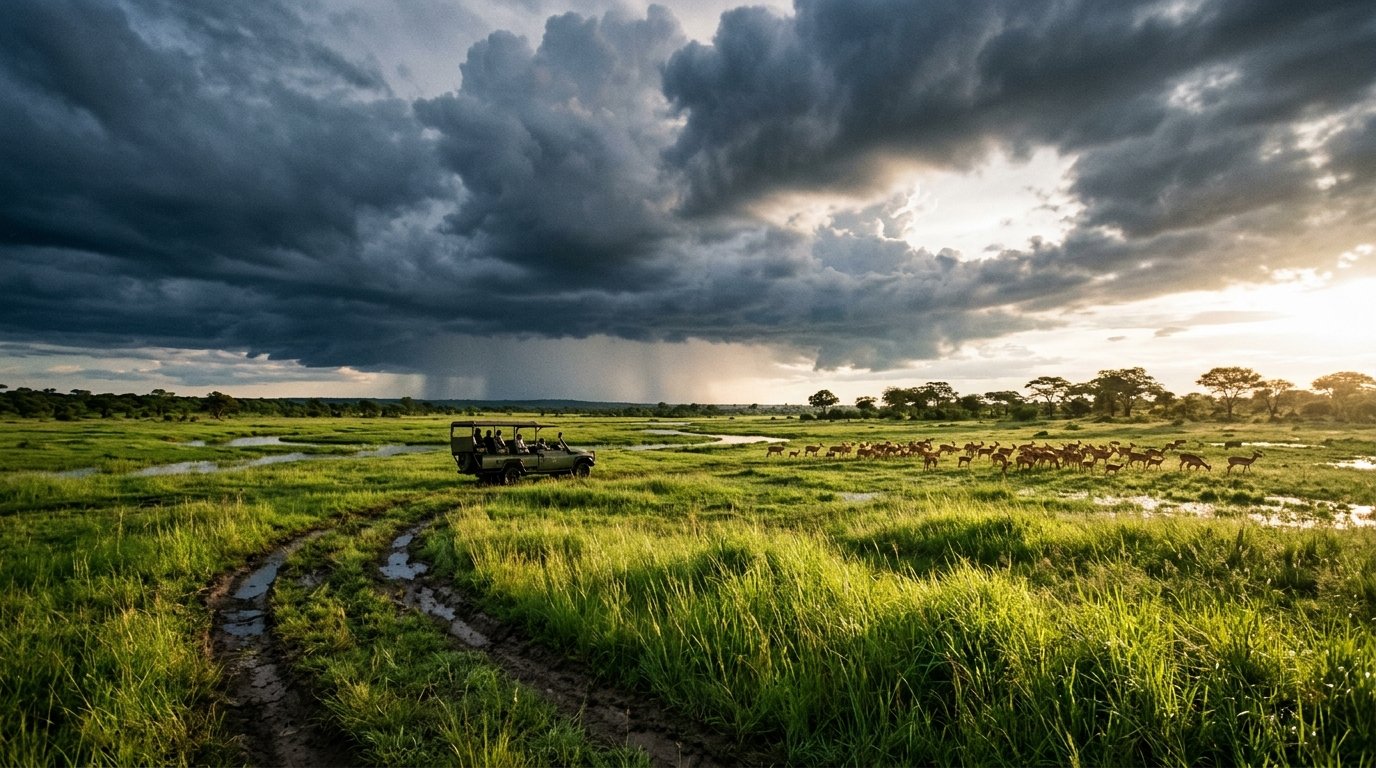
What green season actually looks like
The name is literal. The Kalahari sands of Botswana turn from dust to grass within days of the first real rain. Zambia's Luangwa Valley goes from ochre to a deep saturated green that photographs unlike anything the dry season offers. South Africa's lowveld fills in. The bush becomes dense, which is the honest tradeoff, but it also becomes alive in a way that a parched landscape simply is not.
Rain in this part of the world is not a week of drizzle. It arrives as a dramatic afternoon storm, drops a great deal of water in an hour or two, and clears. Mornings are typically bright. The practical effect on a game drive is that you plan around the middle of the afternoon rather than losing days to weather, which is a very different proposition from a rainy season in Southeast Asia.
The wildlife argument
Green season is calving season. Impala, wildebeest, and zebra drop their young in a narrow window timed to the new grass, which means the plains fill with newborns within a few weeks. Predators follow the obvious logic. Sightings of hunting behavior are more frequent in this period than at almost any other time of year, and the cats are visibly in better condition.
The birding is the other transformation, and it converts people who arrived indifferent to birds. Migratory species arrive in enormous numbers, breeding plumage is at its most extreme, and a camp that logs forty species in September will log well over a hundred in January. Zambia and Botswana in particular become serious birding destinations for three months of the year.
What you give up is density at the waterholes. In the dry season, animals are forced to predictable water, which makes them easy to find. In green season, water is everywhere and so are the animals, spread across a much larger area and screened by taller grass. Sightings take more patience and a better guide. They are frequently more interesting when they come.
The economics are not subtle
Rates in green season run substantially below peak, and the gap is wide enough to change what kind of trip is possible. A camp that sits outside the budget in August is often comfortably inside it in February. Wilton Vida clients tend to use that gap two ways. Some take the same trip for meaningfully less. Others take the trip they actually wanted, staying at the properties they had ruled out, or adding a third camp to a two-camp itinerary.
The second version is the one we recommend. Safari rewards time in one place far more than it rewards covering ground, and green season pricing is the most reliable way to buy more nights without buying a worse camp.
Who should skip it
A first safari with a single week and a determination to see the full complement of large mammals is better served by the dry season. So is a traveler who will be genuinely unhappy in humidity, or one who cannot tolerate an itinerary where a road might wash out and a plan might change by an afternoon. Some camps in Zambia and Botswana close entirely for part of the wet season because access becomes impractical, and the ones that stay open sometimes shift from vehicles to boats as the floodplains rise.
That last point is worth reframing, though. A mokoro through flooded channels or a boat-based approach to game viewing is not a downgrade. For repeat safari travelers it is frequently the best trip they have taken, precisely because it is not the version they had already done twice.
How we build these
Green season is an itinerary that has to be constructed rather than selected from a brochure, because camp access, road conditions, and the calving window all shift by region and by month. Wilton Vida builds these around the specific weeks a client can travel, not around a generic seasonal label, and we are direct when the answer is that a particular camp in a particular February is the wrong call.
Our Travel Leaders Network affiliation gives us the operator relationships and preferred-partner terms that matter most on safari, where value tends to come from added nights, private vehicle arrangements, and guide quality rather than from a discount line on an invoice. We also handle the unglamorous half of the trip, which on a multi-camp safari means light aircraft transfers, strict luggage limits, and a schedule with very little forgiveness in it.
Ask us about Botswana's Okavango in February, Zambia's Luangwa in the emerald months, or a Kruger-adjacent private reserve where the drives run year round. Each is a different trip, and the right one depends on what you have already seen.
Planificamos safaris completos en español, desde los vuelos internos hasta el guía en el campamento.
If a safari has been on the list for years and the budget never quite worked, green season is the answer worth hearing. Reach our team at wiltonvida.com or message us on WhatsApp at https://wa.me/message/YUIL7UEHTZDAM1.