Mediterranean 2028: Why the Best Cabins Go Eighteen Months Out
There is a persistent belief that cruise fares work like airfares — that patience is rewarded, that the smart move is to wait for the panic pricing that arrives when a ship needs to fill. For a certain kind of cabin, on a certain kind of sailing, that is occasionally true. For the cabins most people actually want on a Mediterranean summer, it is almost never true. The rooms that disappear first tend to be the good ones, and they disappear long before the discounting conversation begins.
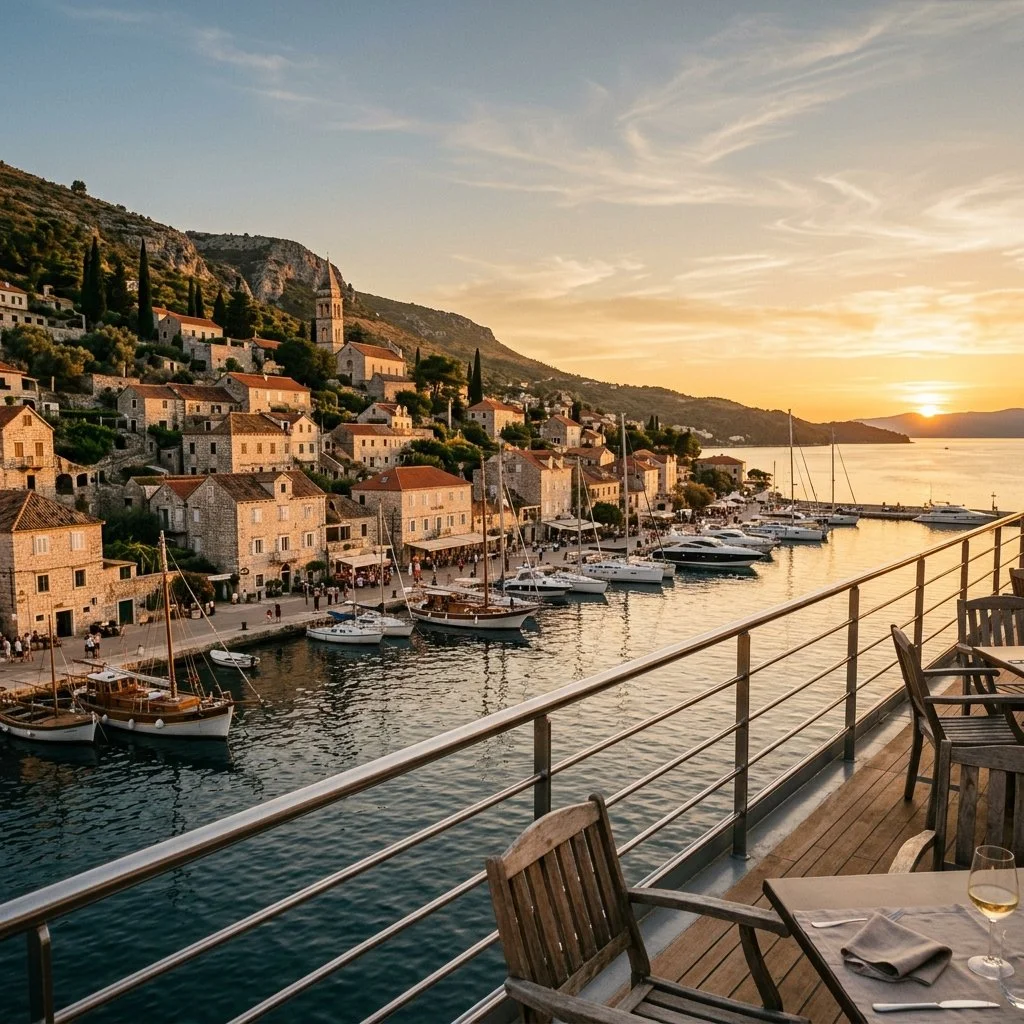
How a New Season Actually Opens
When a cruise line releases a new deployment — say, a Mediterranean season eighteen to twenty-four months ahead — the entire inventory does not hit the open market at once. It moves in waves.
Past guests with loyalty status are typically given first access. Groups and charters are carved out. Advisory networks hold blocked space. Only after those layers are satisfied does the remaining inventory become broadly bookable, and by that point the composition of what is left has already shifted meaningfully.
This matters because cruise inventory is not uniform. A ship might carry two thousand guests across a dozen cabin categories, but the categories people are genuinely competing for — aft-facing balconies, connecting rooms, mid-ship suites on quiet decks, the handful of accessible cabins on each ship — may number in the dozens. On a well-regarded Mediterranean itinerary in peak summer, those specific rooms can be spoken for within days of release.
Why the Cheapest Cabins Are the Last Ones Standing
Here is the part that confuses people about last-minute pricing. When a line drops a fare aggressively close to sailing, it is usually because it needs to move the inventory it has left — and what it has left is, almost by definition, the inventory nobody chose first. Interior cabins under a nightclub. Obstructed-view balconies. Guarantee bookings where you accept a category and the line assigns the room.
If your priority is a low headline fare and you are genuinely indifferent to where you sleep, that is a legitimate strategy and a real saving. If your priority is a specific balcony on a specific deck, waiting does not get you a discount on that room. It gets you a different room.
What Eighteen Months Actually Buys You
Beyond cabin selection, booking far ahead purchases three things that rarely appear in a fare comparison.
The first is deposit structure. Early bookings on most premium lines carry low, often refundable deposits with final payment not due until roughly three to four months before sailing. You are holding a room for a modest sum, with a long runway to change your mind. That asymmetry is the single most underrated feature of booking early.
The second is price protection. Most lines will honor a fare reduction between booking and final payment, either as a rate adjustment or as onboard value. In practice this means an early booking is closer to a floor than a ceiling — you are protected on the downside while holding the inventory you wanted. The specific terms vary by line and by promotion, which is exactly the kind of detail worth confirming before you commit rather than after.
The third is everything surrounding the cruise. Mediterranean summers sell out on land long before they sell out at sea. The pre-cruise hotel night in Barcelona or Rome, the transfer, the private guide in Ephesus, the shore day you actually wanted rather than the coach tour you settled for — those are finite, and they get scarce on exactly the same curve as the good cabins.
The Categories That Vanish First
If you want a working mental model of what to move on early, it looks roughly like this.
Suites and mini-suites on mid-ship decks go first, because they combine space, stability, and proximity. Aft balconies follow, prized for the wake view and the wider terrace. Connecting and adjoining cabins are a small, fixed inventory and are the standard failure point for multigenerational family bookings — there is no way to manufacture more of them in month fourteen. Accessible staterooms are similarly finite and, on many ships, number fewer than a dozen.
Solo cabins, where offered, are also a limited build. And on itineraries with a marquee port day — a scenic sail-in, a rare call — the port-side or starboard-side rooms that favor the view get picked over by travelers who know the route.
Working With an Advisor on a Long Runway
This is where Wilton Vida does its most useful work, and it is not the work most people expect. Anyone can put a name on a cabin. The value is in knowing which cabin, on which deck, on which ship, and when the release is coming.
Through Travel Leaders Network we see deployment announcements and preferred-partner inventory as they open, which means we can position clients ahead of the general release rather than alongside it. We hold space while you decide. We track fare movement between booking and final payment so any reduction gets applied rather than missed. And we build the trip around the sailing — the hotel nights, the private guiding ashore, the return logistics — while those pieces are still genuinely available.
We also tell clients when waiting is the right call. If you are flexible on dates, indifferent to cabin position, and willing to sail on short notice, we will say so. White-glove service is not the same as always saying book now. It is knowing which of the two answers applies to you.
A Mediterranean 2028 season is not a hypothetical planning exercise — the good rooms on it are being selected right now. If a Mediterranean summer is on your list, the conversation to have is which sailing, which ship, and which side of the ship.
Ready to start planning? Reach out to our team at wiltonvida.com or connect with us on WhatsApp at https://wa.me/message/YUIL7UEHTZDAM1
Un mundo. Un amor. Déjanos llevarte allí.