The Notary Stamp Didn’t Match the Signature. Here’s Why That Matters.
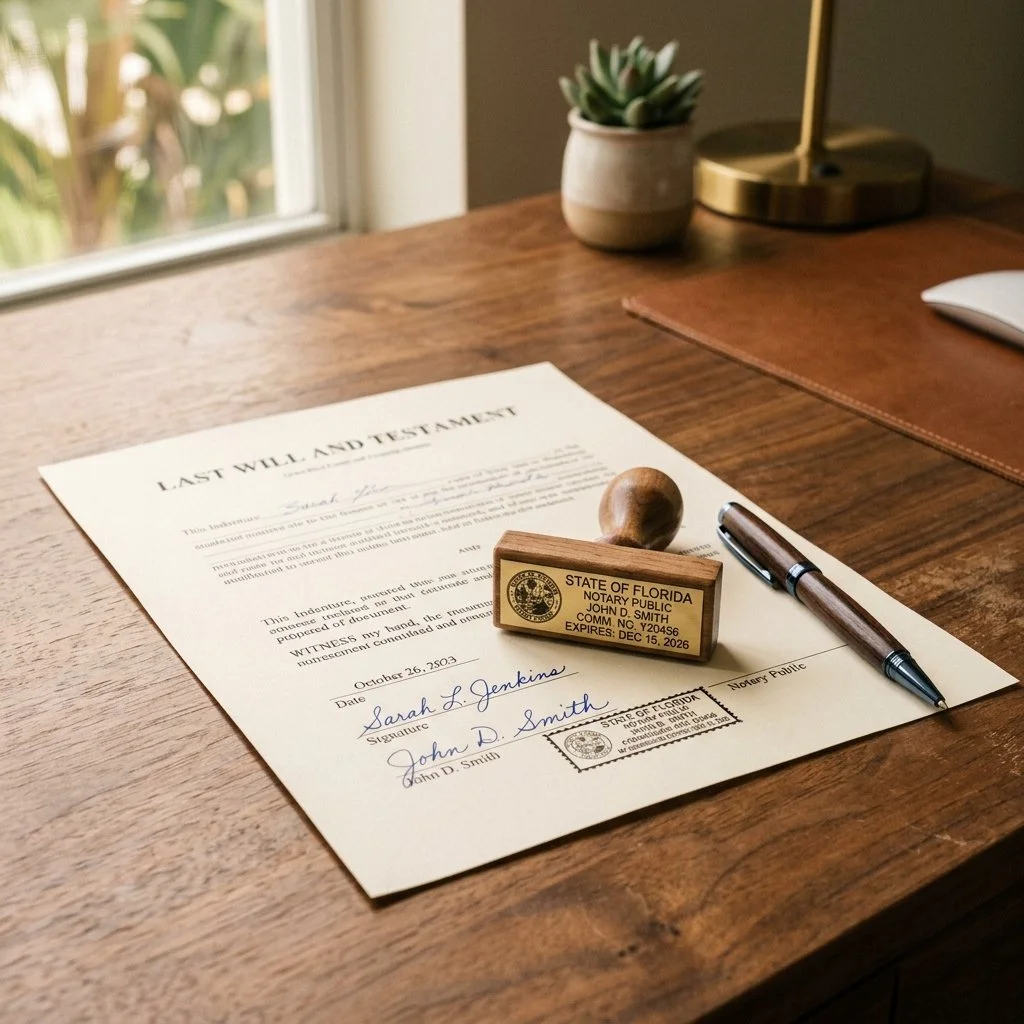
A client came to us with two documents that had already been notarized somewhere else. On paper, everything looked finished — signatures in place, a stamp on each page that needed one, a date filled in. The problem took about four seconds to spot. The name printed inside the notary’s seal did not match the name signed above it.
Those documents were headed for rejection. Not because anyone acted in bad faith, but because a notarization is a chain of small verifications, and one broken link is enough. The client had no idea. Most people wouldn’t.
What a Notary Is Actually Certifying
The common assumption is that a notary confirms a document is valid or that its contents are true. Neither is the job. What a notary certifies is far narrower and, in practice, far more useful: that the person who signed is who they claimed to be, that they appeared before the notary, that they signed willingly and with apparent understanding, and that the notarial act was performed correctly and recorded.
That is the whole value proposition. Years later, when someone questions whether a signature was genuine or whether a signer was pressured, the notarization is the evidence. Which means the integrity of the act depends entirely on the details being right — the commission name matching the signature, the venue and date being accurate, the correct certificate wording for the act performed, and the journal entry existing at all.
How a Mismatch Like This Happens
It is almost never fraud. It is volume and inattention. A notary who signs one commission name and stamps with a seal reflecting a former legal name — after a marriage, a divorce, a commission renewal — creates exactly this discrepancy, and nobody catches it because nobody is looking. Same with the adjacent errors we see constantly: the certificate wording for an acknowledgment used where a jurat was required, a blank venue line, a signer who was not physically present when the document was signed, an undated or incomplete journal.
The pattern behind all of them is the same. The notarization was treated as a stamp rather than as an act, and a stamp takes ninety seconds.
Why the Setting Changes the Outcome
At a retail counter, notarization is a side function. The person performing it is usually helping the next customer in line, working from a laminated reference card, and measuring the interaction in minutes. That is not a character judgment — it is a description of the incentives. Speed is the metric.
A mobile or remote online notary operates on entirely different incentives. The appointment exists for this document and nothing else. There is time to read the certificate wording before signing, confirm that the identification presented actually satisfies the requirement, check that every page needing an initial has one, verify that the signer understands what they are signing, and complete the journal properly. When something is wrong — a missing witness, an unfilled blank, a certificate that does not match the act — there is room to stop and fix it rather than push it through.
The cost difference between the two is small. The cost of a rejected document is not. A refinance that misses its closing window, a power of attorney that fails at the moment it is finally needed, a travel consent letter that does not hold up at a border — those are the outcomes on the other side of a ninety-second notarization.
What to Look For Before You Hand Over a Document
You do not need to know notary law to protect yourself. Four things are enough. Confirm the name signed matches the name in the seal impression. Confirm the venue — county and state — and the date are filled in and correct. Confirm the certificate wording matches what your document or receiving institution actually requires. And ask whether the notary keeps a journal, because a notary who does is a notary who is treating this as a record rather than an errand.
If a document has already been notarized and something looks off, do not assume it will be fine. Bring it to someone who will read it. Correcting a defective notarization before submission is straightforward. Discovering it after a lender, court, or foreign consulate has rejected the filing rarely is.
Where Wilton Vida Fits
Wilton Vida Group provides mobile notary and remote online notarization across South Florida, and the standard is deliberately unhurried. Christopher is an NNA Certified Signing Agent, background screened, NNA member #400164321 — which in plain terms means the training, the annual background screening, and the loan-signing credential that title companies and lenders look for are all current and verifiable.
Practically, it means the document gets read. It means we tell you when something needs a witness you do not have yet, or when the receiving institution is likely to want wording your document does not have, before it becomes a problem instead of after. And it means we come to you — home, office, hospital, title office — or handle it remotely when that is the better fit.
If you have documents that matter, or a stack that has already been notarized and you would like a second set of eyes on them, reach out at wiltonvida.com or message us directly on WhatsApp at https://wa.me/message/YUIL7UEHTZDAM1.
Servicio de notaría en español disponible. Con gusto le ayudamos.