Viking Ocean vs. River Cruises: Which One Fits You?
Same cruise line. Two entirely different vacations. That is the thing almost nobody tells you when you start looking at Viking, and it is the reason we spend more time on this particular conversation than on almost any other in our office.
Viking operates an ocean fleet and a river fleet, and the shared brand language — adults only, Scandinavian design, no casino, no children, no nickel-and-diming — obscures how different the two experiences actually are. The right answer has very little to do with which itinerary looks prettier in a brochure. It has to do with pace, port access, how much ground you want to cover, and what you want the days between the destinations to feel like.
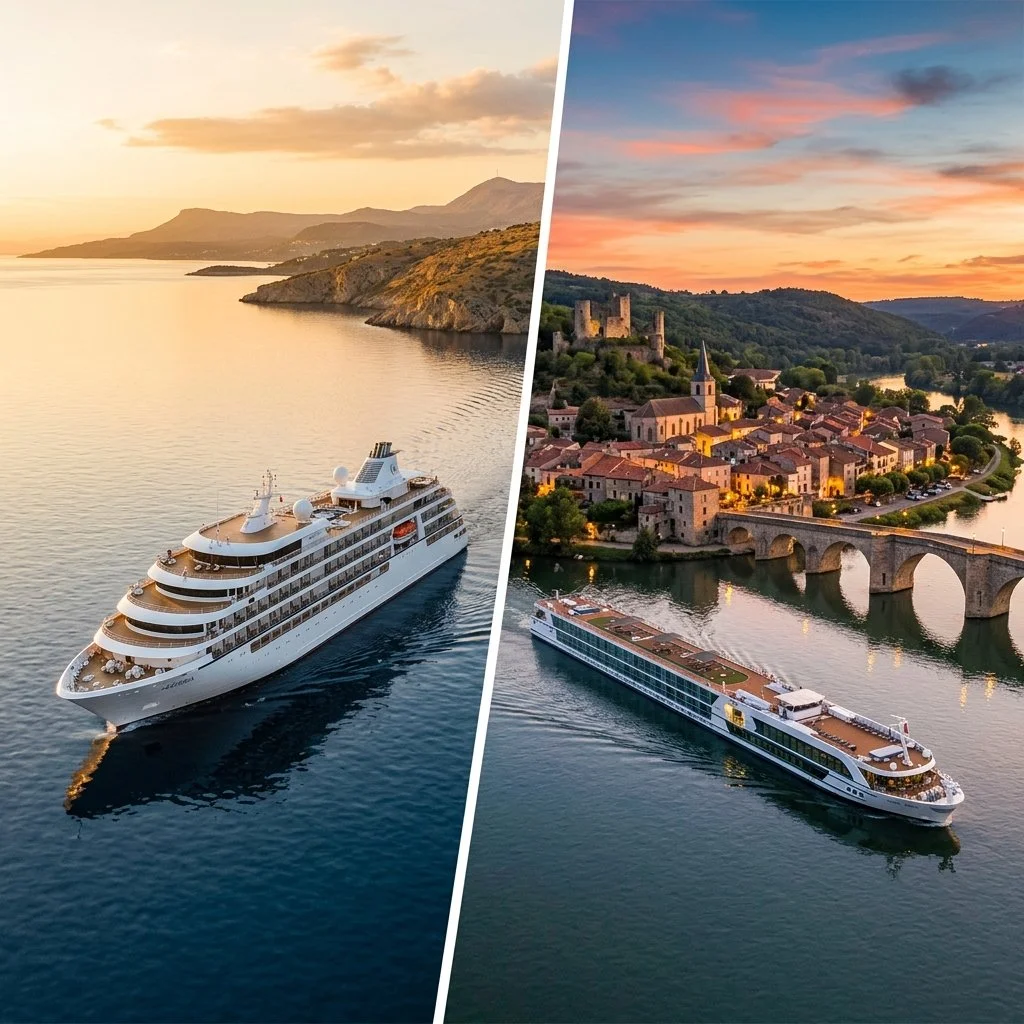
The Ships Are Not the Same Category of Thing
Viking’s ocean ships carry fewer than a thousand guests, which by modern standards makes them small, and every stateroom has a veranda. There is a proper spa with a snow grotto, multiple dining venues, an infinity pool at the stern, a two-deck atrium, and enough room that you can genuinely disappear for an afternoon.
The river longships carry well under two hundred. There is a lounge, a restaurant, a sun deck, and an aquavit terrace, and that is close to the full inventory. You will recognize every face by the second evening. Neither is better. But if the idea of a ship as its own destination appeals to you, the ocean fleet is that and the river fleet emphatically is not.
Sea Days Versus Docking Every Morning
This is the real dividing line. An ocean itinerary includes days at sea, and those days are either the best part of the trip or the worst, depending entirely on who you are. Some clients treasure them — the spa, the library, a book on the veranda, dinner without an agenda. Others come back and tell us the sea days were the part they endured.
River sailing has essentially none. You wake up docked, usually in the middle of a town rather than at a commercial port thirty minutes outside it, walk off the ship into the destination, come back for lunch or dinner, and cruise overnight to the next one. In one week you might touch four countries. The density is remarkable and the pace is relentless. If you want to see a great deal and you do not need downtime built in, the rivers are extraordinarily efficient.
Both fleets include a shore excursion in every port, which is genuinely unusual and worth understanding. It is not a token bus tour — it is a real, guided introduction to the place, and on the rivers it is often walkable from the gangway. Beer and wine come with lunch and dinner on both. Wi-Fi is included. Specialty restaurants on the ocean ships carry no surcharge.
Where the fleets diverge is what you would spend on top. Ocean voyages tempt you toward the spa, premium beverage packages, and the optional excursions in ports where the included tour is not enough. River voyages tempt you toward optional excursions almost every single day, because there is a destination every single day. Neither is a trap. But if you are comparing a river fare to an ocean fare side by side, compare the realistic all-in number, not the base.
A rough guide that holds up more often than not. Choose ocean if you want the ship to be part of the vacation, you value unstructured time, you are covering longer distances, you want a veranda and a spa and a stern pool, or you are traveling on a longer itinerary where sea days are the recovery mechanism that makes the whole thing sustainable.
Choose river if the destinations are the entire point, you would rather be in a town square at nine in the morning than by a pool, you are drawn to Europe’s interior — the Rhine, the Danube, the Douro, the Seine — and you are comfortable with a smaller room in exchange for constant proximity.
The clients who are happiest are usually the ones who eventually do both, in that order. And the ones who are unhappiest are almost always the ones who booked the river because the itinerary read like a greatest-hits list and did not realize they had signed up for a walking-intensive week with no afternoon off.
Where We Come In
Wilton Vida Group is a Travel Leaders Network affiliate, and on a line like this that access matters in concrete ways: advisor-side inventory, amenity opportunities, and stateroom guidance that goes beyond a deck plan. On a river longship in particular, category and position are not interchangeable — there are only a handful of the best rooms and they are gone long before the sailing.
More than that, we ask the questions the booking engine does not. How do you feel about an unstructured day? Are you walking four hours in the morning by choice or by obligation? Is anyone in the party going to need a slower version of this? Those answers determine which fleet you belong on, and getting them right in advance is worth considerably more than any fare difference.
If you are weighing an ocean voyage against a river sailing, let’s talk it through before you deposit anything. Reach our team at wiltonvida.com or message us on WhatsApp at https://wa.me/message/YUIL7UEHTZDAM1.
Hablamos español. Con gusto los ayudamos a elegir el viaje correcto.