A Day Aboard Pure Amazon: What Expedition Cruising in Peru Actually Looks Like
Say “river cruise” to most people and they picture the Danube. A long, low ship, a hundred and fifty guests, a walled town at every mooring, and a bicycle waiting on the dock. That is one product. What happens on the Marañón and the Ucayali, in the flooded forest where they converge to form the Amazon, is a different product entirely — and the vocabulary we share for both of them causes real confusion at the point of booking.
Twelve Suites, Twenty-Two Guests
Pure Amazon carries a maximum of twenty-two guests across twelve suites on a vessel of roughly one hundred and fifty-eight feet. Those numbers are the entire design thesis. Every suite runs panoramic glass along the outer wall, so the forest is present from the bed rather than from a promenade deck. There are three skiffs aboard and three naturalists, which means excursion groups are genuinely small — often five or six people to a boat — and can be split by interest and by stamina rather than herded on a single schedule.
That ratio is what separates expedition river travel from river cruising as most travelers understand it. On a European itinerary, the ship is the transport and the town is the destination. Here the ship is the base camp, and the destination is whatever the skiff reaches at first light.
What the Day Actually Runs Like
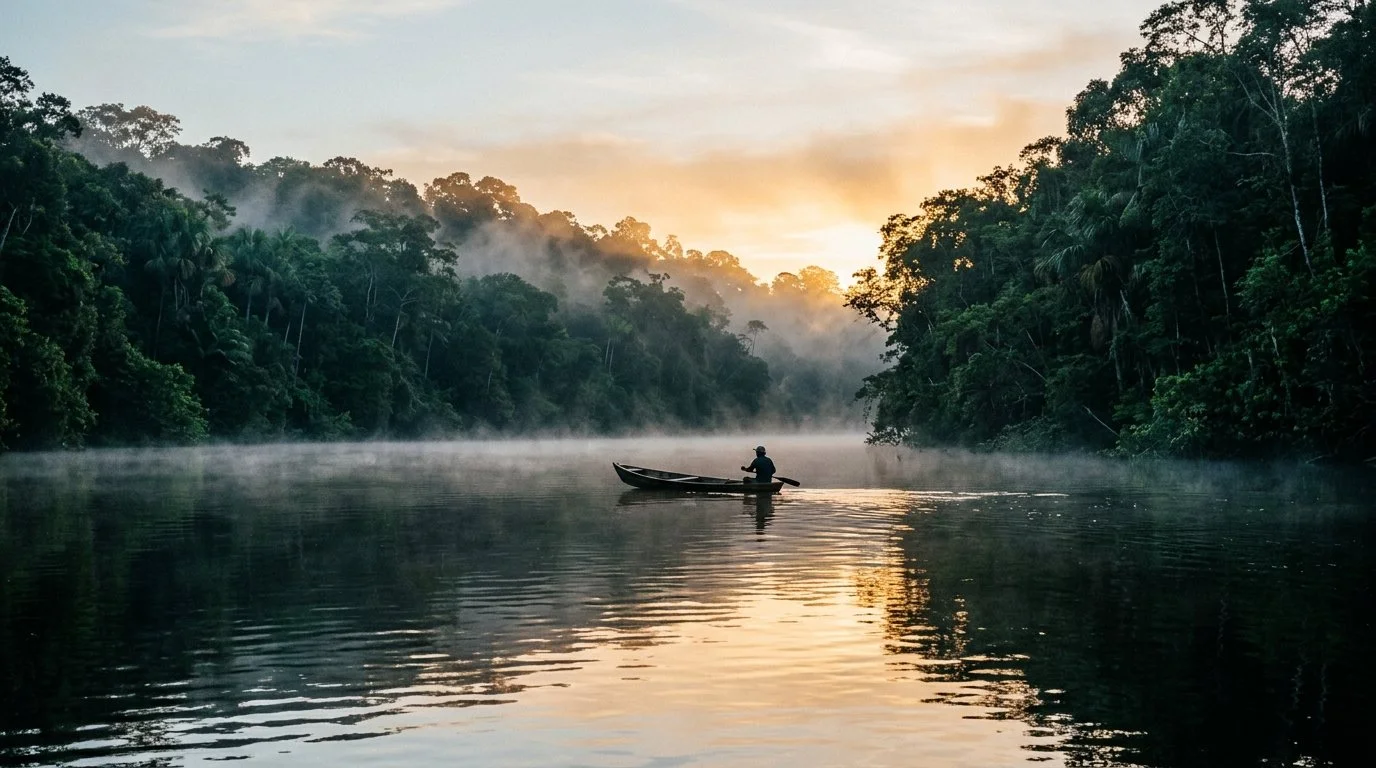
It starts before the heat does. Dawn is the productive window in the Amazon — the birds are moving, the water is glass, and the mist is still lifting off the black surface of the tributary. The first skiff goes out early, usually before breakfast, and it is the excursion most guests come to protect. Kingfishers, orioles, macaws, black-collared hawks. Pink river dolphins if the morning cooperates, though nobody sensible promises them.
Back aboard for breakfast, then the middle of the day belongs to the boat. The heat is real and the wildlife knows it. This is when the vessel repositions, when you sit with a naturalist and understand what you saw, when the panoramic glass earns its keep because the forest is simply moving past you at reading speed.
Late afternoon brings the second excursion. Depending on the day and the water level this might be a jungle hike, kayaking through a still lagoon, piranha fishing on a catch-and-release basis, or a visit to one of the riverside communities. Dinner is a multi-course affair with South American wine pairings and ingredients sourced from the region — Amazon fish, jungle fruit, native produce — cooked with more ambition than the setting would lead you to expect.
Then, if you stay up, the part almost nobody plans for. There is no light pollution for hundreds of miles. The night sky over the reserve is the kind of thing that reorganizes people’s sense of scale, and it costs nothing but staying awake.
The Pacaya-Samiria Reserve
The itineraries work the Pacaya-Samiria National Reserve, a protected area of roughly five million acres — somewhere near eight thousand square miles — in northeastern Peru. It is one of the largest protected wetlands in the Amazon basin, and its defining feature is seasonality. In high water the forest floods and the skiffs move through the canopy itself, threading between trunks in what is genuinely a submerged forest. In low water the channels contract, the beaches emerge, and the wildlife concentrates around the remaining water, which makes sightings easier and the geography more legible.
Neither season is better. They are different trips, and choosing between them is one of the few decisions on this itinerary that genuinely benefits from an advisor who has thought about it. A first-time visitor chasing wildlife density and a returning traveler chasing the flooded-forest experience should not book the same month.
Sailings typically run three, four, or seven nights, with the vessel repositioning between excursion sites rather than holding a fixed mooring.
How This Differs From European River Cruising
Four ways, and they matter at the booking stage.
Scale is the obvious one. Twenty-two guests versus a hundred and fifty changes everything downstream — the excursion groups, the dining room, the noise level, how quickly the staff learn your name.
Excursion structure is the second. There is no walking tour of an old town. Everything happens by skiff, in small groups, twice a day, on a schedule set by light and heat rather than by opening hours.
The third is what “included” means. Expedition itineraries of this type build in the naturalist guiding, the excursions, and the gear — binoculars, muck boots, rain ponchos, insect repellent, and sun protection are typically provided aboard, which meaningfully reduces what has to come in your luggage. European river cruising prices excursions very differently.
The fourth is expectation setting. A European itinerary delivers what the brochure shows, on the day it says. An expedition itinerary delivers whatever the river offers that morning. Guests who understand that before departure have a far better week than guests who arrive with a checklist.
Getting There, and Why That Is Part of the Planning
Access is through Iquitos, which is not connected to the rest of Peru by road. That is not an inconvenience to be routed around — it is a fact that shapes the entire trip design, because the flight in and out has to be built into the itinerary with genuine buffer. From South Florida, this typically means a connection through Lima, and the sequencing of those connections against the sailing date is where an itinerary either works comfortably or works barely.
Most travelers pair the Amazon segment with Machu Picchu or the Sacred Valley, and that pairing has its own altitude logic. Going from river level to Cusco’s elevation without an acclimatization plan is a common and entirely avoidable mistake.
Where Wilton Vida Comes In
This is a category where advisor value is not a marketing line. Season selection, cabin position, the domestic air sequencing through Lima and Iquitos, the altitude ordering if you are adding the Andes, and the honest conversation about what an expedition itinerary does and does not guarantee — all of that sits upstream of the booking, and none of it is visible on a product page.
Through Travel Leaders Network we have supplier access and inventory visibility on a vessel where twelve suites means availability is genuinely finite. On a boat this small, a preferred month can be gone eighteen months out.
If Peru’s Amazon is on your list, or if you have been weighing expedition travel against a European river itinerary and want the difference explained properly, let’s talk. Reach out to our team at wiltonvida.com or connect with us on WhatsApp at https://wa.me/message/YUIL7UEHTZDAM1
Estamos aquí para ayudarle en español también — escríbanos y con gusto le atendemos.