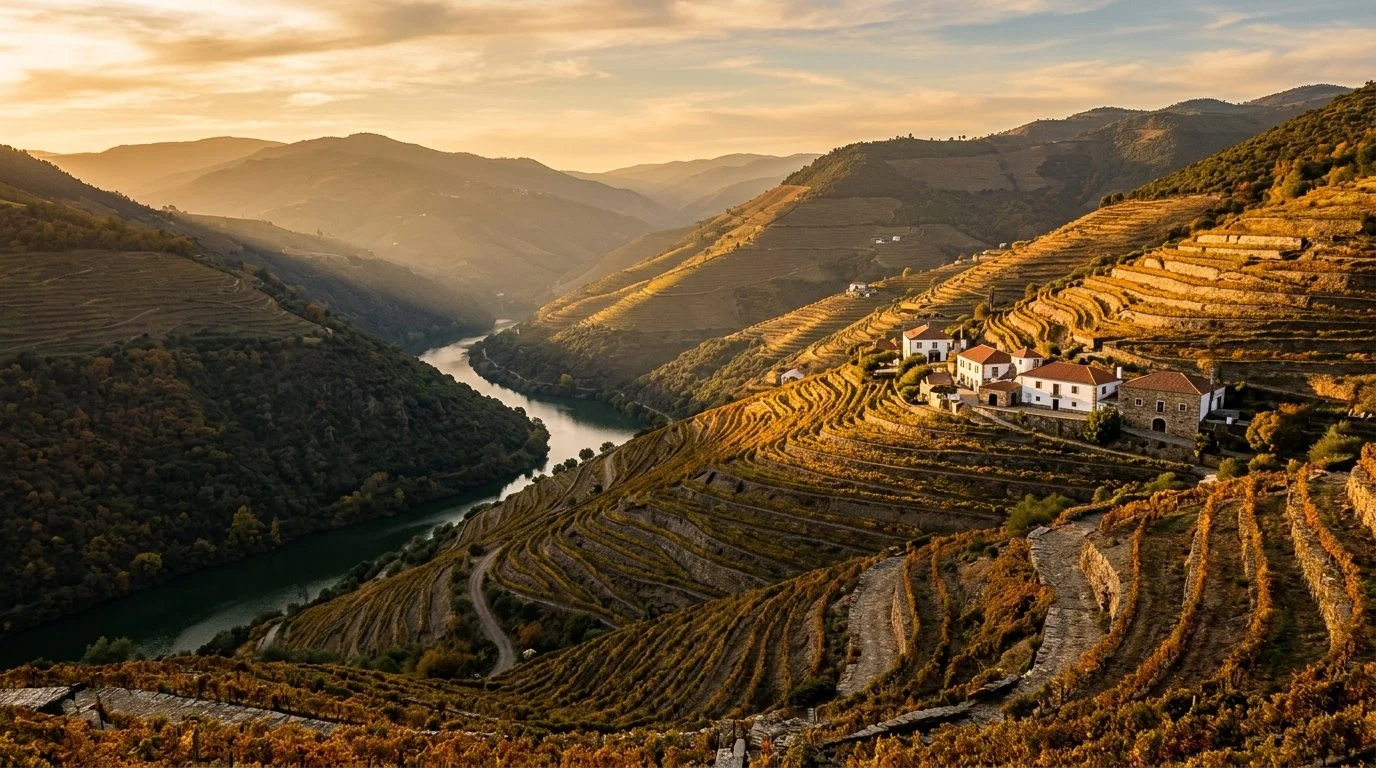
The Douro is the oldest demarcated wine region on earth, mapped and regulated before most European nations held their current borders. The river is still the honest way to see it. Every terrace on those hillsides was cut by hand, most of them centuries ago, and they were cut to face the water.
Lisbon to Porto, at the speed of the water. Here is what the journey actually feels like, and what to know before you commit a week to it.
Why the River Reads Differently Here
Most river itineraries in Europe move between cities, and the countryside is what passes by between them. The Douro inverts that. The cities anchor either end, and the valley itself is the destination. For long stretches there is no town in sight at all, only terraced vineyards climbing several hundred feet from the water and the occasional whitewashed quinta with a terracotta roof tucked into the vines.
The valley is also narrow and deeply carved, which means the scenery is close. On the Rhine or the Danube the banks are often a comfortable distance away. Here the hillsides rise steeply on both sides and the terraces are near enough to pick out individual vines from the sun deck. Guests who have done several river cruises consistently describe the Douro as the most visually intimate of them.
Then there are the locks. The Douro is heavily engineered, and one of its locks carries vessels through one of the tallest lifts in Europe. Watching a ship rise inside a concrete chamber taller than a building is an oddly compelling piece of theater, and it happens more than once.
Lisbon First, and Why That Matters
Many travelers treat Lisbon as an airport with a city attached. That is a mistake worth correcting with two or three nights on the front end.
Lisbon is a city of hills, tiled facades, and neighborhoods that reward walking badly and slowly. The historic quarters are steep enough that the funiculars are genuine transport rather than novelty. The food is unpretentious and very good, the wine lists are a bargain by any Western European standard, and the city has a melancholy warmth that takes a day or two to register.
Practically, the front-end nights also absorb the transatlantic arrival. Flying in from South Florida means landing tired, and a river itinerary that starts the morning you arrive is a week that starts at a deficit. We build the buffer in as a default rather than an upsell.
The Valley, Day by Day
The heart of the trip is the run upriver from Porto into the wine country, and the days settle into a rhythm quickly. Mornings tend to be quiet cruising through the terraces. Afternoons bring the quintas.
Those estate visits are the substance of the week. Many have been held by the same families for generations, and the tastings happen in working cellars rather than in a visitor center built for buses. You will learn more about fortified wine in three afternoons than in years of reading about it, largely because the people pouring it grew up in the rows outside.
The valley towns are small and genuinely old. Expect granite, expect steep streets, and expect a pace that refuses to be rushed. One of the better excursions crosses the Spanish border to Salamanca, a university city of golden sandstone that feels like a deliberate change of key mid-week.
The insider tip we give clients: the upriver stretch above Pinhao is the most dramatic scenery on the entire route, and some itineraries do it overnight while everyone is asleep. Ask when you book whether that section is sailed in daylight. It is the difference between seeing the Douro and reading about it.
Porto at the End
Porto earns its position as the finish. The city stacks itself along a gorge, the two banks connected by bridges that are landmarks in their own right, and the lodges where port has aged for two centuries sit directly across the water from the old town.
Plan at least two nights here rather than transferring straight to the airport. The lodge tours are worth doing properly, the seafood is excellent, and the city at dusk from the upper deck of the main bridge is the image most people carry home.
Practical Notes Before You Book
Two things shape the Douro experience more than the vessel you choose. The first is season. Spring brings green terraces and cool mornings, autumn brings harvest activity and ochre hillsides, and high summer in the valley gets genuinely hot with little shade on the upper decks. Most clients who care about photographs choose autumn.
The second is mobility. Quinta visits frequently involve uneven granite, stone stairs, and steep approaches, and the charming valley towns are charming partly because nothing has been flattened for convenience. Anyone with knee or hip limitations should hear that before booking rather than discover it at the first estate. The itineraries can be adapted, but the adaptation needs to be planned in.
Wilton Vida builds these weeks as a complete journey rather than a sailing with transfers bolted on. Through our Travel Leaders Network affiliation we access cabin inventory and onboard amenities that do not surface on public booking pages, and our Marriott Platinum Elite standing gives clients real leverage on the Lisbon and Porto hotel nights that frame the trip. We also know which vessels sail the best stretches in daylight, which is not information the brochures volunteer.
If a week in the oldest wine region in the world sounds like your speed, the conversation to have is about timing and which direction you sail, not which search filter to use.
Estamos aquí para acompañarte en cada paso del camino.
Ready to start planning? Reach out to our team at wiltonvida.com or connect with us on WhatsApp at https://wa.me/message/YUIL7UEHTZDAM1.