Thirty Documents, Thirty Stories: What I Notarize Every Day
On a busy day I will notarize somewhere between thirty and fifty documents. Most of them are unremarkable in the best sense — a form, a signature, a stamp, a handshake, and everyone gets on with their day.
But three keep coming back. Not because they are complicated, but because of what is happening in the room when they get signed. After a while you stop thinking of them as document types and start thinking of them as situations.
Travel Consents for Kids
A parent is sending a child somewhere without them. Sometimes it is a grandmother taking the grandkids to see family for a month. Sometimes it is a school trip, or a divorced parent’s summer custody arrangement, or a competition in another country.
What they need is a consent letter, notarized, and what they usually do not know is how specific it has to be. Full names. Dates. Destination. Who is traveling with the child and in what capacity. Both parents’ signatures where both parents have rights. Contact information that someone at a border can actually use.
I have seen these done casually — a paragraph, a signature, a stamp — and I have heard what happens when a border officer or an airline agent decides the paragraph is not enough. The document exists for exactly one moment, and that moment happens far from home with a child standing next to you. It is worth twenty extra minutes.
The Bedside Signings
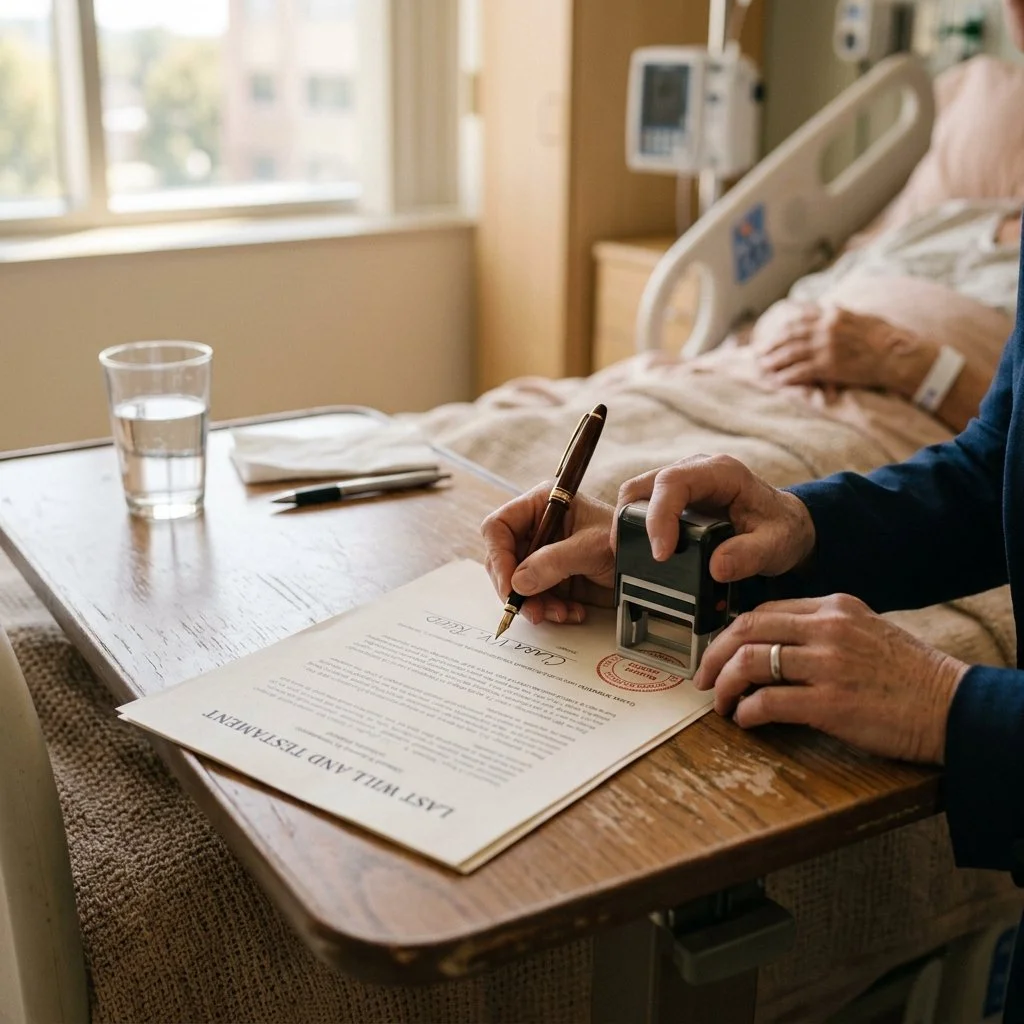
These are the appointments I take seriously in a different way. A hospital room, a rehabilitation facility, sometimes a hospice. Someone’s family is trying to get paperwork in order and the timeline is not theirs to control.
The documents vary — powers of attorney, healthcare directives, financial authorizations, and sometimes a will or a codicil.
On wills and codicils specifically, I want to be direct about how we handle it: Wilton Vida handles those in person, as a matter of our own policy, and I do not advise anyone on how a will should be drafted or executed. That is the attorney’s work, and I say so plainly to every family that asks me. I am there to perform a notarial act correctly and to keep a proper record of it — nothing more, and nothing less.
What I can bring to that room is patience. Confirming the signer understands what is in front of them. Making sure the identification requirement is genuinely satisfied rather than approximately satisfied. Noticing that a required witness is not actually present, and saying so before signatures happen rather than after. Slowing down when someone is medicated, tired, or grieving, and being willing to stop entirely if something does not feel right.
That last one matters most. A notary’s real authority is the ability to decline. Most people never see it used, and it is the whole reason the office exists.
Tow-Yard and Title Releases
The least emotional of the three, and the most time-sensitive. A vehicle is sitting somewhere accruing a daily charge, and the release requires a notarized signature from someone who is frequently not in the same city — or occasionally not in the same country.
These are the appointments where remote online notarization earns its reputation. A signer in another state, a document that cannot wait until Thursday, and a storage fee climbing every day. Handled remotely, it is a twenty-minute problem. Handled by mail, it is a four-hundred-dollar one.
What They Have in Common
Very little on the surface. A child’s summer, a family’s hardest week, and a car in a lot.
Underneath, the same thing. Each of those documents exists because at some future point, somebody is going to question whether the signature is real and whether the person meant it. A border officer. A financial institution. A sibling. A court. When that moment comes, the only evidence is the notarization — whether the details were right, whether the identification was actually checked, whether there is a journal entry, and whether the notary was paying attention.
That evidence is either there or it is not. It cannot be added later.
Why I Don’t Rush
I am an NNA Certified Signing Agent, background screened, NNA member #400164321. The credential means the training and the annual screening are current and verifiable, which matters to title companies and lenders. But it is not the reason I take the time.
The reason is that I have seen what a rushed notarization costs on the other end, and the person paying that cost is never the notary. It is a family at a border. It is someone discovering that the document they needed does not hold. Ninety seconds saved at the counter is not saved at all — it is borrowed against a worse day.
So we come to you. Home, office, hospital, title office, or remotely when that is genuinely the better fit. We read the document. We tell you when something is missing before it becomes a problem instead of after.
If you have something that matters — or a stack you would like a second set of eyes on — reach us at wiltonvida.com or message directly on WhatsApp at https://wa.me/message/YUIL7UEHTZDAM1.
Servicio de notaría en español disponible. Con gusto le ayudamos.